

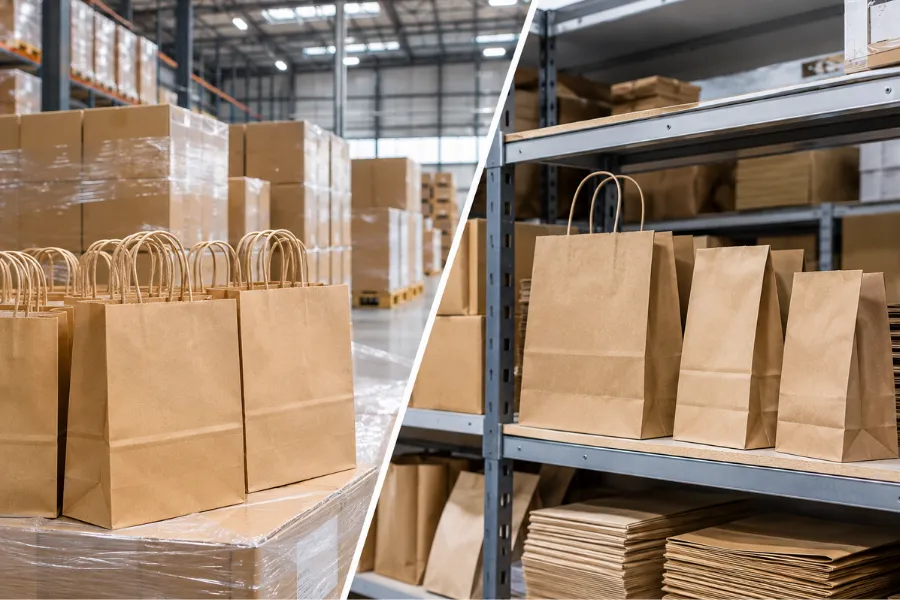
For restaurants and packaging distributors, buying takeout paper bags from China may reduce production costs on planned bulk orders. Local suppliers can be more practical for smaller purchases, stocked products, and urgent replenishment.
The decision changes when you account for freight, import duties, minimum order quantities (MOQs), quality requirements, and inventory costs. A lower factory price may not produce a lower delivered cost.
To compare suppliers fairly, use identical bag specifications and evaluate the total cost, delivery reliability, and inventory commitment required by each sourcing option.
China vs. Local Takeout Paper Bag Suppliers: Quick Comparison
Supplier location alone does not establish manufacturing capability. A local distributor may resell imported bags, while a domestic manufacturer may produce custom sizes and printed designs.
Confirm whether each supplier manufactures the bags, customizes existing stock, or distributes finished products before comparing quotations.
| Comparison Factor | China Suppliers | Local Suppliers |
|---|---|---|
| Unit Price | May offer lower production pricing at larger volumes | Depends on manufacturing costs, stock availability, and distributor margins |
| MOQ | Often influenced by printing setup, materials, and production runs | Stocked bags may be available in smaller quantities |
| Customization | May support custom dimensions, handles, and printing | Depends on production equipment and printing capabilities |
| Lead Time | Production, export preparation, freight, customs, and delivery | Stocked items may ship quickly; custom orders require production time |
| Shipping | International freight and import arrangements | Usually domestic transportation |
| Inventory | Larger shipments may increase storage and working capital needs | Smaller, more frequent purchases may be possible |
| Quality Control | Requires approved samples, documented specifications, and inspection | Requires the same product verification, even for local stock |
| Typical Application | Planned bulk purchasing and repeat custom orders | Standard bags, smaller orders, and short-notice replenishment |
The comparison should be based on the actual supplier and product rather than assuming every Chinese manufacturer or local distributor operates the same way.
Which Option Is More Cost-Effective?
Compare Landed Cost, Not Just Factory Price
A factory quotation may exclude transportation, customs-related expenses, inspection, and final delivery. A local quotation may already include some of these costs in its selling price.
For imported paper bags, calculate the total acquisition and delivery cost using the relevant expenses:
- Bag manufacturing and printing.
- Printing plates, setup, and sample charges.
- Export packing and international freight.
- Applicable customs duties and import fees.
- Customs brokerage and handling.
- Domestic transportation to the delivery location.
- Inspection costs and expected losses from damaged or defective bags.
Use the following calculation:
Landed cost per usable bag = Total acquisition and delivery cost / Number of usable bags received
For example, if 20,000 bags are delivered but only 19,500 meet the agreed specifications, divide the total cost by 19,500 rather than 20,000.
Use the same cost boundary for both suppliers. If a local supplier quotes delivery to your warehouse, the imported quotation should also include the costs needed to reach that warehouse.
Inventory financing, storage, and stockout exposure can then be evaluated separately as part of the broader sourcing decision.
An Illustrative Cost Comparison
Consider a restaurant group purchasing 20,000 custom-printed kraft paper takeout bags from either a Chinese manufacturer or a local supplier.
Both quotations cover identical dimensions, paper specifications, handle construction, printing, and quality requirements.
The figures below are hypothetical. They illustrate purchasing calculations, not current market prices. The assumed import charges are calculation placeholders, not estimates of actual duties.
| Cost Item | China Supplier | Local Supplier |
|---|---|---|
| Bag production | $1,600 | $2,800 |
| Setup and sampling | $150 | $100 |
| Freight and delivery | $650 | $180 |
| Assumed import duties and fees | $300 | $0 |
| Inspection and other acquisition costs | $100 | $20 |
| Total delivered cost | $2,800 | $3,100 |
| Cost per bag | $0.1400 | $0.1550 |
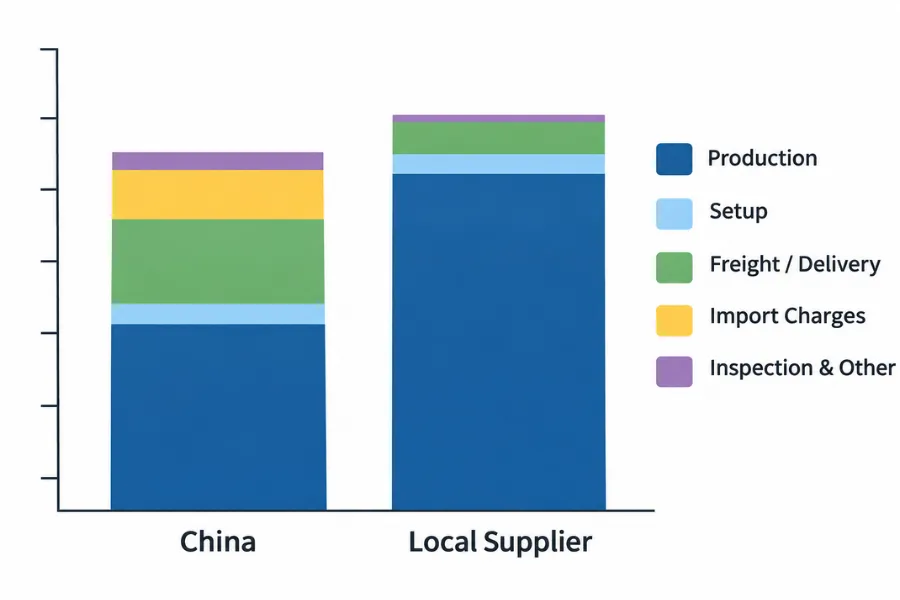
Assuming all bags are usable, the Chinese quotation is $300 lower.
The local supplier’s $0 direct import duty entry means the buyer is not separately paying an import charge in this example. If the local supplier resells imported bags, import-related costs may already be reflected in its selling price.
How Additional Costs Change the Decision
The original $300 advantage is relatively small compared with the total order value. Additional freight, import charges, or other acquisition costs could eliminate it.
| Additional China Sourcing Cost | China Total Cost | Cost per Bag | Lower-Cost Option |
|---|---|---|---|
| $0 | $2,800 | $0.1400 | China |
| $150 | $2,950 | $0.1475 | China |
| $300 | $3,100 | $0.1550 | Equal |
| $500 | $3,300 | $0.1650 | Local |
| $800 | $3,600 | $0.1800 | Local |
In this example, $300 is the break-even amount for additional Chinese sourcing costs. These scenarios assume the local quotation remains unchanged.
Actual purchasing decisions should also account for usable yield, inventory holding costs, and the financial consequences of late delivery.
When Does Bulk Importing Make Financial Sense?
Bulk purchasing can reduce the per-bag impact of fixed expenses such as printing setup and sampling. Larger, efficiently packed shipments may also improve freight cost per bag.
However, the savings must justify the inventory commitment.
For example, a restaurant using 5,000 bags per month would hold approximately six months of inventory after receiving a 30,000-bag order, assuming stable consumption and no existing stock.
That commitment may be reasonable for a standardized bag used across multiple locations. It is less attractive when branding, menu packaging, or bag dimensions may change.
Request quotations at several realistic quantities and compare:
- Delivered cost per usable bag.
- Total cash required for each order.
- Months of inventory represented by the purchase.
- Warehouse capacity and storage costs.
- Risk of unused packaging after a design change.
The appropriate order quantity balances production economics with inventory exposure.
MOQ and Customization: What Changes With Order Size?
Standard Bags vs. Custom-Printed Bags
Standard kraft bags can be suitable when existing dimensions, construction, and appearance meet the restaurant’s needs.
For example, SOS paper bags may be appropriate for takeaway applications that do not require carrying handles, provided the selected size and construction suit the contents.
Custom-printed bags introduce production variables that can affect MOQ and setup charges.
| Customization Element | Specification to Confirm | Purchasing Impact |
|---|---|---|
| Dimensions | Width, gusset, and height | Affects container fit and production setup |
| Paper | Type, GSM, and surface characteristics | Influences material selection and handling performance |
| Handles | Twisted paper, flat paper, or none | Changes construction and attachment requirements |
| Printing | Artwork, colors, and coverage | May require printing preparation and setup |
| Bottom | Fold design, bonding, and reinforcement | Influences bag construction and load performance |
| Surface Treatment | Coating or finishing requirements | Must suit the intended application |
| Carton Packing | Quantity and dimensions per carton | Affects freight volume and storage |
A supplier’s MOQ may apply to each size, design, or printing configuration rather than the combined purchase.
For example, an order containing 5,000 bags in each of three sizes may not qualify for the same unit price as 15,000 identical bags.
How to Compare MOQs
Ask each supplier to quote the same specifications at your expected initial quantity and projected repeat-order volume.
Confirm whether:
- Each bag size has a separate MOQ.
- Different artwork designs require separate production runs.
- Setup charges apply again to repeat orders.
- Multiple sizes can be combined in one shipment.
- Changing paper or handle construction affects the MOQ.
For a café testing new packaging, a smaller order may justify a higher unit price because it limits unused inventory.
For a restaurant chain with standardized bags and stable consumption, larger production runs may offer better economics if replenishment can be planned accurately.
How to Evaluate Takeout Paper Bag Quality
Takeout paper bags used for fast food packaging must accommodate food containers, repeated lifting, and the handling conditions of takeaway or delivery service.
A bag that looks acceptable when empty may fail when its contents create concentrated pressure on the bottom or uneven loads at the handles.
Paper Strength, Handles, and Bottom Construction
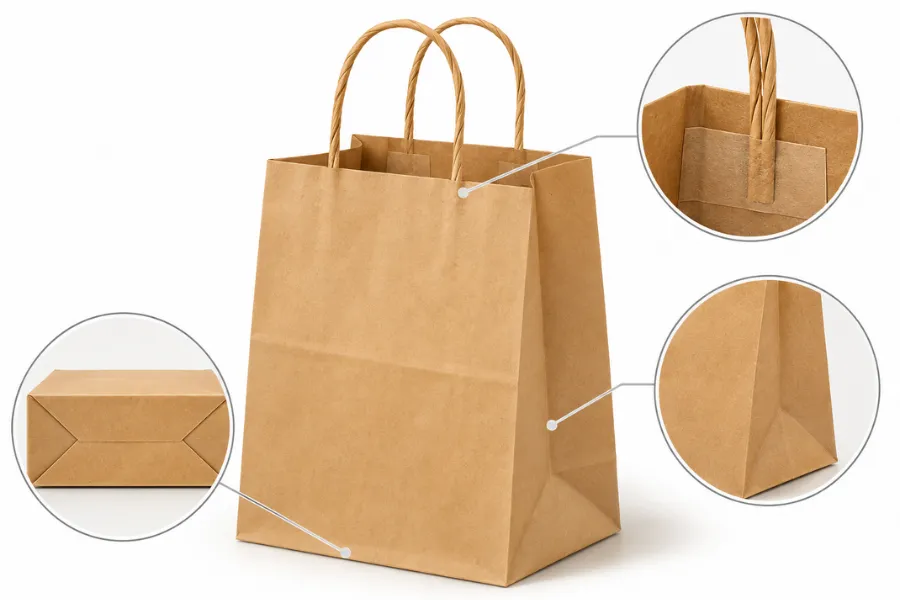
Paper grammage, expressed in grams per square meter (GSM), describes paper mass per unit area. It does not independently establish the load capacity of a finished bag.
Bags with identical GSM can perform differently because of paper properties, dimensions, folds, adhesives, and handle attachment methods.
| Component | What to Inspect | Practical Significance |
|---|---|---|
| Paper | Grade, GSM, stiffness, and surface | Influences handling and resistance to damage |
| Dimensions | Width, gusset, and height | Determines container fit and available base area |
| Bottom | Folds, adhesive bonding, and reinforcement | Supports the contents during lifting |
| Handles | Material, attachment, and reinforcement | Transfers the carried load to the bag structure |
| Seams | Bonding consistency and visible separation | Affects structural integrity |
| Printing | Registration, consistency, and surface condition | Helps maintain appearance across batches |
A wide-bottom bag may accommodate rectangular meal boxes more securely than a narrow bag with similar overall capacity.
Load distribution is equally important. Two containers positioned evenly on the bottom create different stresses from one heavy container pressing against a single side.
When evaluating paper bags with handles, inspect both the handle attachment points and the bottom structure using the intended packed load.
Test Bags Under Real Foodservice Conditions
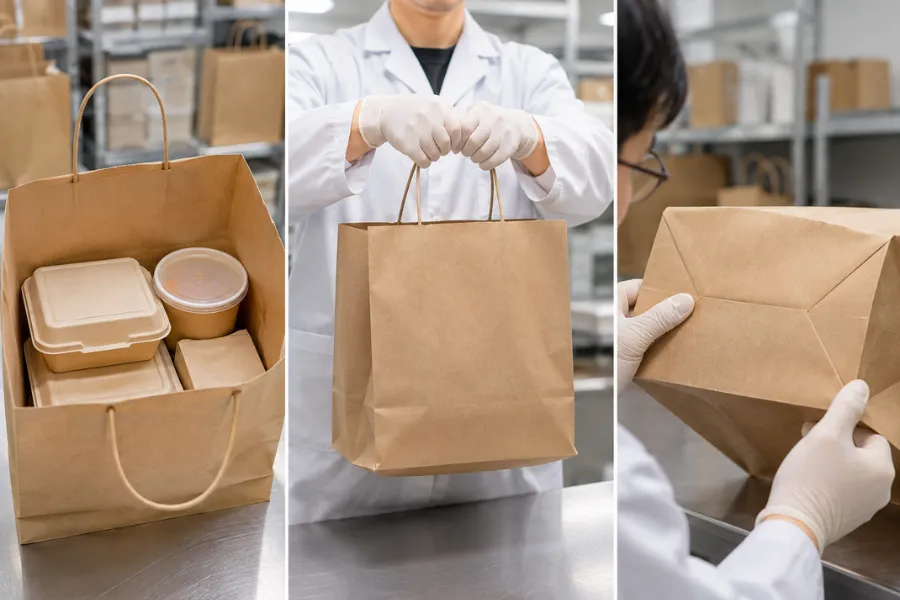
Test samples using actual food containers rather than estimating performance from paper thickness alone.
A repeatable evaluation should record the bag dimensions, packed contents, total load, handling conditions, and observed results.
| Test | Procedure | What to Record |
|---|---|---|
| Container Fit | Pack the intended takeaway containers | Fit, clearance, base support, and bag deformation |
| Loaded Carrying | Lift and carry the packed bag under defined conditions | Handle movement, seam stress, and structural changes |
| Handle Inspection | Repeat the agreed lifting procedure | Attachment damage or separation |
| Bottom Inspection | Examine the base after carrying | Fold deformation, adhesive separation, or tearing |
| Moisture Exposure | Expose samples to representative condensation or incidental moisture | Softening, staining, or loss of structural performance |
| Dimensional Check | Measure samples against the approved specification | Differences in width, gusset, and height |
For container-fit testing, use the actual takeaway boxes, food bowls and buckets, and drink carriers intended for the bag.
A bag used for sealed bakery boxes may not require the same moisture evaluation as one carrying hot meals or cold drinks that produce condensation.
Define the test load and acceptance criteria before approval. If a specific carrying capacity is required, agree on an appropriate test method rather than treating an informal demonstration as a certified load rating.
Retain an approved reference sample and document the relevant tolerances for repeat production.
Lead Times, Shipping, and Inventory Planning
Compare Complete Delivery Schedules
For overseas orders, request separate dates for each major stage:
- Specification and sample approval.
- Artwork confirmation.
- Production completion.
- Export preparation and shipment.
- Customs clearance.
- Final warehouse delivery.
A quoted production lead time does not include every subsequent transportation and clearance stage.
For local suppliers, distinguish stocked inventory from made-to-order production. A nearby custom manufacturer may require more time than a distributor holding finished bags in stock.
Ask each supplier to provide the estimated delivery date, not only the manufacturing completion date.
Also confirm the shipping terms and which party arranges freight, customs clearance, and final delivery.
Calculate When to Reorder
A restaurant group using 2,000 bags per week must account for expected consumption throughout the replenishment period.
Use:
Reorder point = Expected demand during replenishment lead time + Safety stock
If demand during replenishment is estimated at 12,000 bags and the business maintains 4,000 bags of safety stock, the reorder point is 16,000 bags.
This example is illustrative. Safety stock should reflect actual demand variation, delivery uncertainty, and the consequences of running out.
A buyer should also compare the planned delivery date with the latest acceptable arrival date. If the order cannot arrive before inventory reaches its minimum acceptable level, the sourcing plan needs adjustment.
When Dual Sourcing Makes Sense
A restaurant chain may purchase planned bulk quantities overseas while maintaining a local source for emergency replenishment.
This approach is most useful when packaging shortages would disrupt operations and the local supplier can provide an acceptable substitute within the required timeframe.
However, a backup supplier only reduces risk if its products meet the same essential requirements.
Confirm dimensions, container fit, carrying performance, and appearance before relying on alternative stock.
Import Duties and Food Packaging Compliance
Import Duties and Trade Measures for U.S. Buyers
In 2024, the U.S. Department of Commerce issued antidumping and countervailing duty orders covering certain paper shopping bags from China.
These measures do not automatically apply to every paper bag used for restaurant takeaway or food delivery.
The written scope of the applicable measure determines coverage. Product dimensions, construction, materials, origin, and relevant exclusions may affect the assessment.
Before calculating import costs, verify:
- The exact product description and construction.
- The applicable Harmonized Tariff Schedule classification.
- Whether the product falls within a trade remedy scope.
- Current applicable duties and import fees.
- Country-of-origin and documentation requirements.
- Responsibility for customs clearance and related expenses.
A product’s tariff classification alone should not be treated as conclusive evidence that a trade remedy applies.
Where classification or scope is uncertain, consult a qualified customs broker or trade specialist before relying on an estimated landed cost.
Food-Contact Suitability Depends on Intended Use
An outer carry bag holding sealed takeaway containers has a different intended use from a paper bag that directly contacts unpackaged pastries or other food.
For direct food-contact applications, the relevant materials and components must be suitable for the intended conditions and applicable destination-market requirements.
Important variables include:
- Food type, including dry, aqueous, acidic, or fatty products.
- Expected contact temperature.
- Contact duration.
- Paper composition and surface treatments.
- Coatings, inks, adhesives, and other relevant components.
Ask the supplier to identify the exact material specifications and provide supporting documentation for the intended food-contact application.
A generic “food grade” statement does not establish suitability for every food type or temperature.
FSC certification addresses forest-based sourcing and chain-of-custody claims, while ISO 9001 concerns quality management systems. Neither automatically establishes direct food-contact suitability.
Evaluate Environmental Claims Through Product Evidence
Book A, Chapter 23, discusses supplier environmental management and packaging evaluation criteria, including recyclable or reusable transport packaging, renewable materials, recycled content, and cost considerations.
These criteria can help buyers assess supplier documentation and product design. They do not establish that paper bags from one country are inherently more sustainable than those from another.
When environmental performance matters to your purchasing policy, request information about material sourcing, recycled content, coatings, relevant certifications, and the scope of any environmental claims.
The assessment should reflect the actual product and supply chain, including transportation and relevant end-of-life conditions.
Which Supplier Is Right for Your Restaurant or Packaging Business?
Small Restaurants and New Food Businesses
For restaurants with uncertain demand, the main purchasing risk may be excess inventory rather than a slightly higher unit price.
A smaller order of standard bags can help establish which sizes fit the menu before committing to custom printing.
Compare the cost of additional local orders with the storage and obsolescence risk of a larger imported shipment.
Local supply is particularly useful when demand changes frequently or when available stock meets the required specifications.
Restaurant Chains and High-Volume Buyers
For a restaurant chain, purchasing decisions should reflect combined demand across locations and the distribution system used to replenish them.
Standardized bag specifications make bulk purchasing easier to manage, but the buyer must account for warehouse capacity, delivery to individual restaurants, and differences in regional demand.
Compare annual delivered cost and inventory requirements rather than evaluating one factory quotation in isolation.
Overseas sourcing becomes more practical when the chain can approve samples, forecast demand, and place orders far enough ahead of the required delivery date.
Food Packaging Wholesalers and Distributors
Wholesalers must balance the purchasing economics of core products with the cost of holding slower-moving sizes.
For example, a distributor may import frequently ordered takeout bag sizes while purchasing specialty sizes locally when customer demand arises.
Evaluate sales frequency, carton packing efficiency, storage requirements, and the risk of unsold inventory for each product.
A mixed sourcing model is most useful when the savings on high-volume items exceed the additional costs of managing multiple suppliers.
A Practical RFQ Checklist for Comparing Suppliers
Send each supplier the same product specifications and request quotations at comparable quantities and delivery terms.
| RFQ Item | Information to Provide |
|---|---|
| Application | Restaurant takeaway, bakery, café, or delivery |
| Dimensions | Width × gusset × height, with units |
| Paper | Type, GSM, surface, and treatments |
| Construction | Handle type, bottom design, and reinforcement |
| Printing | Artwork, colors, and coverage |
| Quantity | Initial volume and expected repeat orders |
| Samples | Physical samples and approval requirements |
| Quality | Test conditions, tolerances, and inspection criteria |
| Packing | Bags per carton, carton dimensions, and gross weight |
| Delivery | Destination, required arrival date, and shipping terms |
| Documentation | Applicable material, food-contact, or sourcing evidence |
| Commercial Terms | Payment conditions, setup charges, and exclusions |
Request a cost breakdown showing which services and expenses are included.
For international quotations, confirm the named place and responsibilities under the agreed Incoterm. Different terms can shift freight costs, customs responsibilities, and transportation risk between the buyer and seller.
Ask whether manufacturing, printing, and finishing are performed in-house or outsourced when those arrangements affect quality control or scheduling.
Before mass production, approve the physical sample, final specifications, packing method, and inspection requirements in writing.
Frequently Asked Questions
Are takeout paper bags cheaper when imported from China?
They may be cheaper for larger planned orders, but the comparison depends on delivered cost, applicable duties, usable yield, and inventory expenses. A lower factory price is not sufficient evidence of savings.
Can I order small quantities of custom takeout paper bags from China?
Availability depends on the bag size, material, printing setup, and supplier production requirements. Ask whether the MOQ applies separately to each size or artwork design.
How can I check paper bag quality before importing?
Test physical samples with your actual food containers and a defined load. Record handle performance, bottom integrity, dimensions, and moisture response against agreed acceptance criteria.
Are imported paper bags suitable for food packaging?
Suitability depends on the intended use and materials. Direct food-contact applications require documentation relevant to the specific food type, temperature, and contact conditions.
Should restaurant chains use both local and overseas suppliers?
Dual sourcing can reduce replenishment risk when a local supplier can provide compatible bags during an overseas delay. Confirm substitute product specifications and the cost of maintaining backup supply.
Final Recommendation
Choose a supplier based on comparable delivered costs, verified product performance, and a replenishment schedule that matches your demand.
China sourcing may be suitable for standardized bulk orders with sufficient planning time. Local purchasing may be preferable when order quantities are smaller, demand is uncertain, or rapid replenishment is essential.
For wholesale or custom takeout paper bag procurement, request a packaging quote using your bag dimensions, paper requirements, handle construction, printing specifications, quantity, and delivery destination. Comparable specifications make it easier to identify the sourcing option that meets your operational and financial requirements.