

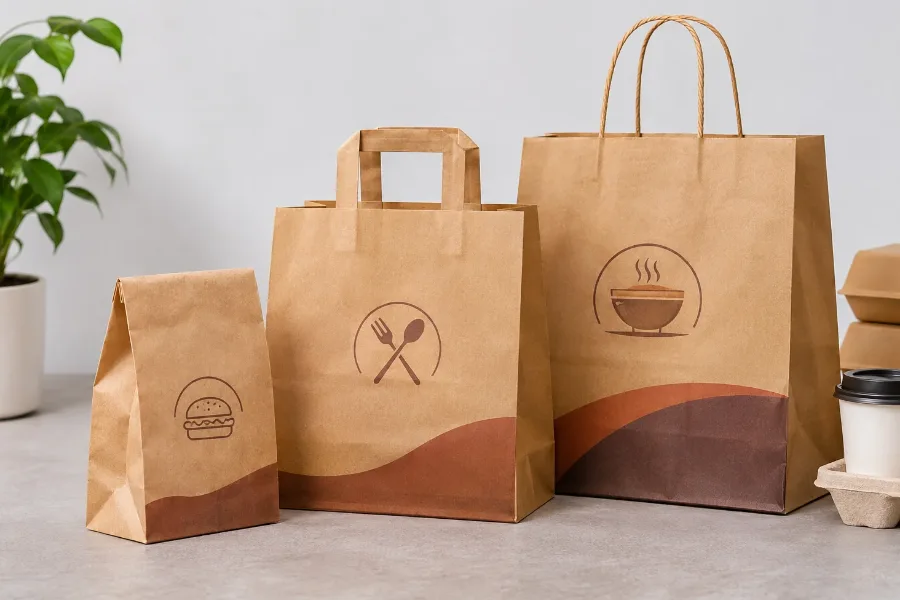
Published U.S. supplier prices show that custom printed takeout paper bags can cost around $0.16 each for small SOS bags ordered in quantities of 5,000, while larger handled bags can cost more than $1 each at lower order quantities. These are examples of different products, not a universal market price range.
Your actual cost depends on bag dimensions, paper grade, handle construction, printing requirements and order quantity. Artwork setup, shipping and other charges can increase the final cost beyond the listed unit price.
For restaurants, bakeries, coffee shops and food packaging distributors, comparing bags with equivalent specifications is essential. A lower-priced bag may not be suitable if its dimensions, bottom construction or handles cannot accommodate the intended food containers.
Custom Takeout Paper Bag Prices by Type and Quantity
Published supplier prices vary substantially between small handleless bags and larger handled carryout bags.
The following examples come from publicly available U.S. supplier listings and pricing guides reviewed in November 2026.
| Supplier | Bag specification | Quantity | Listed price per bag | Price source |
|---|---|---|---|---|
| Ecoally | Printed SOS bag, 4.7 × 2.8 × 8.5 inches | 500 | $0.56 | Published pricing guide |
| Ecoally | Same printed SOS bag | 1,000 | $0.33 | Published pricing guide |
| Ecoally | Same printed SOS bag | 5,000 | $0.16 | Published pricing guide |
| Imprint5 | Kraft takeout bag, 14 × 10 × 15.5 inches, twisted handles | 500 | $1.27 | Product listing |
| Imprint5 | Same kraft takeout bag | 1,000 | $1.02 | Product listing |
| Imprint5 | Same kraft takeout bag | 5,000 | $0.88 | Product listing |
| AVCO Boxes | Selected custom printed paper handle bags | 400 minimum | From approximately $0.45 | Product collection listing |
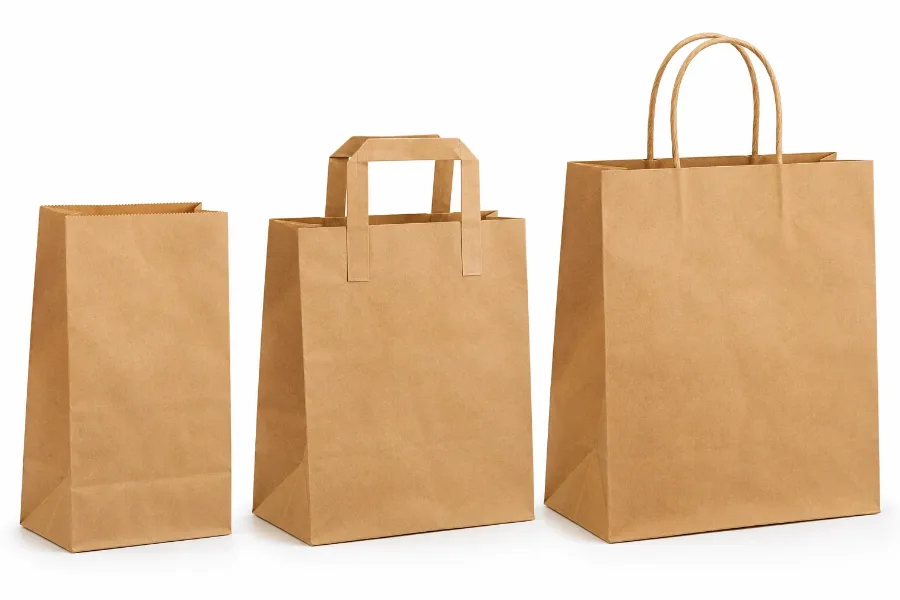
Prices were reviewed in November 2026 and may change. These examples represent different products and pricing sources, not standardized quotations for identical bags. Setup fees, shipping, taxes and selected printing configurations may affect the final price.
Handleless SOS Paper Bags
SOS stands for self-opening sack. These bags have a flat bottom and folded side panels that allow them to stand upright when opened.
They are commonly used for bakery products, sandwiches, snacks and smaller takeaway orders. ENTEN’s SOS paper bags are relevant to businesses comparing this construction for foodservice applications.
Because SOS bags do not require separate handles, they avoid the material and attachment operations associated with handled bags. However, their suitability depends on the weight, dimensions and handling requirements of the contents.
Paper Bags With Handles
Handled paper bags are commonly used for takeaway orders containing several food containers or products that customers need to carry over longer distances.
Flat paper handles and twisted paper handles use different materials and attachment methods. ENTEN’s paper bags with handles provide relevant options for businesses evaluating these constructions.
Handle materials, attachment areas and reinforcement requirements contribute to the final bag cost. The appropriate design depends on the expected load rather than handle appearance alone.
Large Takeout and Catering Bags
Large paper bags accommodate family meals, multiple containers and selected catering orders.
Their greater dimensions increase paper consumption, while the bottom structure and handle attachment must suit the combined weight of the contents.
When comparing quotations, use equivalent bag dimensions, paper weights, handle structures and printing specifications. Otherwise, differences in unit price may reflect different products rather than better supplier pricing.
What Factors Affect the Cost of Custom Takeout Paper Bags?
1. Paper Material and GSM
Kraft paper is widely used for takeaway bags because it can be folded, converted and assembled into different bag structures.
Natural brown kraft and white paper are common options. Their costs depend on paper grade, supplier, finish and production requirements rather than color alone.
GSM means grams per square meter. It measures paper mass per unit area, not paper thickness.
For the same bag pattern and paper material, increasing GSM increases the amount of paper used.
Consider a hypothetical bag pattern requiring 0.20 square meters of paper before manufacturing waste.
| Paper weight | Theoretical paper mass per bag |
|---|---|
| 80 GSM | 16 g |
| 100 GSM | 20 g |
| 120 GSM | 24 g |
| 150 GSM | 30 g |
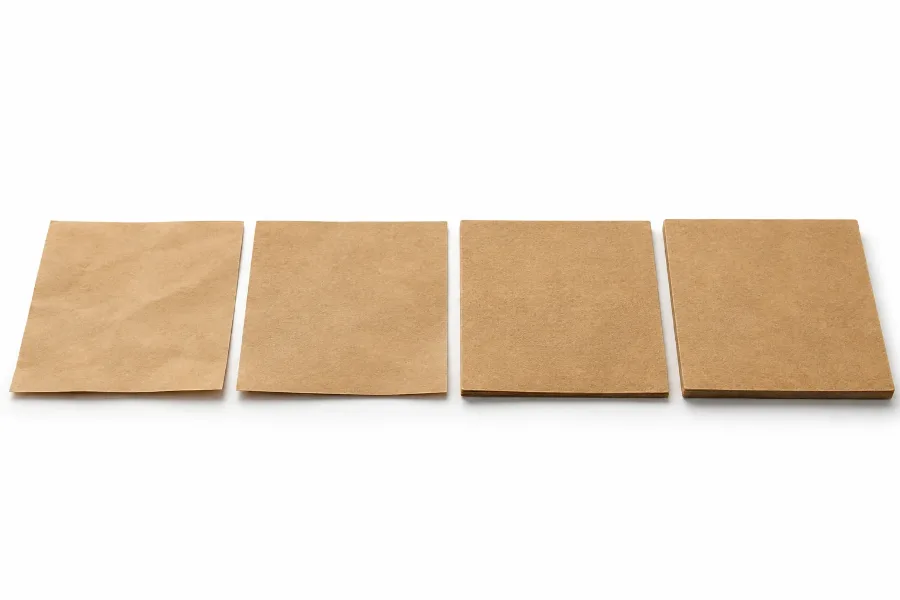
These calculations exclude handles, adhesives, reinforcement materials and manufacturing waste.
A 150 GSM paper uses 50% more paper mass than a 100 GSM paper of the same area. The finished bag will not necessarily cost 50% more because printing, converting, labor and other expenses also contribute to its price.
Higher GSM does not automatically guarantee better carrying performance. Paper quality, fiber characteristics, seams, handle attachment and moisture exposure also influence the strength of the finished bag.
When comparing paper weights, request samples made with the proposed materials and test them using representative food containers.
2. Bag Size and Gusset Dimensions
Paper bag dimensions are commonly specified as width, depth and height.
For foodservice applications, usable bottom dimensions are particularly important because they determine whether containers can sit flat inside the bag.
For example, an 8 × 6-inch meal container needs sufficient internal bottom space for its footprint. A bag with inadequate depth may force the container to tilt, even if its height and front width appear sufficient.
Before selecting a bag size, check:
- The width and depth of the largest food container.
- Whether containers will be stacked or placed side by side.
- Space required for napkins, utensils and packaged side dishes.
- The combined weight of a typical order.
- Whether the bag must remain upright during packing and transport.
Nominal external dimensions may differ from usable internal dimensions because of folds, seams and construction tolerances.
For a new bag specification, test the actual container arrangement inside a physical sample before approving production.
3. Handle Type and Bag Construction
Handle construction affects material consumption, manufacturing operations and carrying performance.
| Handle type | Construction | Common application | Cost consideration |
|---|---|---|---|
| Handleless SOS | Folded paper bag with a square bottom | Bakery items, sandwiches and light takeaway orders | No separate handle materials or attachment |
| Flat paper handle | Folded paper strips attached to the bag | Restaurants, cafes and pickup counters | Requires handle materials and attachment |
| Twisted paper handle | Twisted paper cords attached to the bag | Multi-container orders and retail-style takeaway | Additional handle conversion and assembly |
| Reinforced die-cut handle | Cutout opening with suitable reinforcement | Selected carryout applications | May require extra material and converting work |
These differences do not establish a universal price or strength ranking.
A twisted handle is not automatically stronger than a flat handle. The load performance of a finished bag depends on the handle material, attachment area, paper strength and overall construction.
For heavier takeaway orders, test the complete bag with representative containers rather than evaluating handles separately.
4. Logo Printing and Artwork Requirements
Printing costs depend on the number of colors, printed area, artwork complexity, printing method and setup requirements.
A small one-color logo may require less preparation than a multicolor design covering several panels.
Flexographic printing uses printing plates and can be suitable for repeat orders and higher production volumes.
Digital printing does not require conventional printing plates and may be suitable for certain shorter runs or variable designs. However, its cost and availability depend on the equipment, material and bag construction.
Not every printing method is available for every bag format.
When comparing quotations, confirm whether the price includes:
- One-sided or two-sided printing.
- The specified number of colors.
- Printing plates and artwork preparation.
- Digital or physical proofs.
- Color matching.
- Additional surface finishing.
If your branding allows alternative designs, request quotations for a one-color version and a multicolor version using identical bag specifications and order quantities.
This isolates the cost difference associated with printing rather than mixing printing changes with material or structural changes.
5. Minimum Order Quantity and Production Volume
Minimum order quantity, or MOQ, is the smallest quantity a supplier accepts for a specific bag configuration.
MOQ depends on the manufacturing arrangement.
Printing onto an existing standard bag may require a smaller order than producing a custom size with a new construction and printing setup.
When requesting prices, distinguish between:
- Custom printing on an existing standard bag.
- Custom dimensions using an established bag construction.
- Fully customized bag construction and printing.
These options may have different minimum quantities, setup charges and production costs.
How Does Order Quantity Affect Custom Paper Bag Pricing?
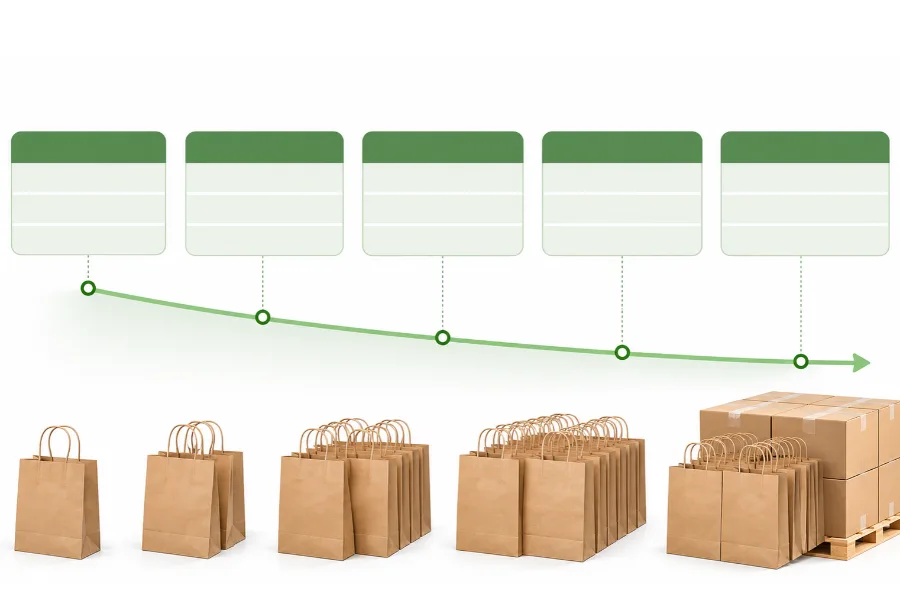
Certain production expenses, including machine setup and order administration, can be distributed across more units when order quantities increase.
A published Imprint5 listing for a kraft takeout bag measuring 14 inches wide, 15.5 inches high and 10 inches deep illustrates the effect.
| Order quantity | Listed unit price | Bag subtotal |
|---|---|---|
| 500 | $1.27 | $635 |
| 1,000 | $1.02 | $1,020 |
| 2,500 | $0.94 | $2,350 |
| 5,000 | $0.88 | $4,400 |
| 10,000 | $0.84 | $8,400 |
These are published product prices. Setup charges, printing configurations, shipping and other applicable expenses may affect the final order cost.
Increasing the order from 500 to 1,000 reduces the listed unit price by approximately 20%.
Increasing the order from 5,000 to 10,000 reduces the unit price by approximately 4.5%.
The additional unit-price savings become smaller at higher quantities in this example. Buyers should therefore compare the incremental savings at each quantity tier rather than assuming the largest order provides the best overall purchasing outcome.
Should You Order 1,000 or 5,000 Bags?
Consider a hypothetical restaurant comparing two quotations for the same bag specification.
| Cost factor | Option A | Option B |
|---|---|---|
| Order quantity | 1,000 | 5,000 |
| Unit price | $0.35 | $0.24 |
| Bag subtotal | $350 | $1,200 |
| Monthly usage | 800 | 800 |
| Estimated supply | 1.25 months | 6.25 months |
Illustrative pricing only. The example excludes shipping, setup fees and inventory holding costs.
Option B reduces the unit price by approximately 31%, but requires $850 more in initial bag expenditure.
At 800 bags per month, the larger order provides approximately five additional months of inventory.
That may be suitable for a restaurant with stable branding, predictable demand and sufficient storage. A business with seasonal packaging changes or limited storage may prefer the smaller order.
Use the following calculation to estimate inventory coverage:
Months of Supply = Order Quantity ÷ Average Monthly Usage
For a more complete decision, compare the unit-price savings with storage expenses, cash tied up in inventory and the likelihood of unused stock.
What Additional Costs Affect Custom Paper Bag Pricing?
Artwork Setup and Printing Plates
Some suppliers charge separately for artwork preparation or printing equipment setup.
For example, AVCO Boxes lists a $75 artwork setup fee for a new custom order. Its published ordering information indicates that repeat orders using artwork already on file may avoid repeating the original setup charge.
Other suppliers may include setup expenses in the unit price or charge separately for printing plates.
Before ordering, confirm whether setup charges apply per design, color, bag size or order, and whether unchanged artwork can be reused.
Sampling and Proofing
A digital proof helps verify logo placement, artwork layout and colors.
A physical sample is needed to assess dimensions, bottom construction, handle attachment and container fit.
For a new bag design, ask whether the supplier can provide a sample made from the proposed paper grade and construction.
Confirm sample charges and whether any amount can be credited toward the production order.
Shipping and Freight
Paper bags are lightweight relative to many rigid packaging products, but their packed carton volume can contribute significantly to freight costs.
Shipping charges depend on carton dimensions, shipment weight, quantity, transportation method and delivery destination.
For imported packaging, customs clearance, duties, taxes and local transportation may also apply, depending on the destination and shipping terms.
Compare quotations using the same delivery basis. A factory-gate price and a delivered warehouse price do not include the same cost components.
Other Possible Charges
Additional charges may include custom tooling, special finishing, storage or expedited production.
Request an itemized quotation that separates unit prices, setup fees, sampling, transportation and optional services.
This makes it possible to identify which charges are one-time expenses and which may recur with future orders.
How to Calculate the Total Cost of Custom Takeout Paper Bags
The listed unit price is only one component of the purchasing budget.
Calculate the total order cost using:
Total Order Cost = Bag Cost + Setup Fees + Shipping + Other Applicable Charges
Then calculate the effective unit cost:
Effective Cost per Bag = Total Order Cost ÷ Number of Bags Purchased
These formulas cover the charges included in the purchase. Storage, inventory financing and other operating costs should be evaluated separately when comparing larger orders.
Example: Ordering 2,000 Custom Paper Bags
Consider a hypothetical restaurant ordering 2,000 custom printed paper bags.
| Cost component | Amount |
|---|---|
| 2,000 bags at $0.28 each | $560 |
| Artwork setup | $80 |
| Shipping | $150 |
| Total order cost | $790 |
The effective unit cost is:
$790 ÷ 2,000 = $0.395 per bag
The quoted bag price is $0.28, but the effective purchasing cost is approximately $0.40 after the assumed setup and shipping charges.
These are illustrative figures, not an ENTEN quotation or a verified supplier offer.
Calculate the Cost per Usable Bag
Transportation damage, manufacturing defects or specification mismatches can reduce the number of usable bags received.
Suppose the 2,000-bag order has an assumed 2% unusable rate.
Usable Bags = 2,000 × (1 − 0.02) = 1,960
Cost per Usable Bag = $790 ÷ 1,960 = Approximately $0.403
The 2% figure is a hypothetical assumption, not an expected manufacturing defect rate.
For actual purchasing decisions, use inspection results, supplier quality records and agreed acceptance criteria to estimate usable quantities.
Consider Packaging Cost per Takeout Order
A restaurant may use different numbers of bags depending on the size of each customer order.
If the effective bag cost is $0.40 and average consumption is 1.2 bags per takeaway order:
Packaging Bag Cost per Order = $0.40 × 1.2 = $0.48
This calculation excludes food containers, napkins, utensils and other packaging materials.
Tracking bags used per order can reveal avoidable packaging expenses. For example, reducing unnecessary double-bagging may lower the cost per order without changing suppliers or bag specifications.
How to Reduce Custom Takeout Paper Bag Costs Without Sacrificing Quality
The most useful cost reductions come from matching bag specifications to actual foodservice requirements.
| Foodservice application | Main bag requirement | Cost consideration |
|---|---|---|
| Bakery and pastry counter | Suitable size for individual products | Avoid oversized bags |
| Coffee shop | Space for small food containers and packaged snacks | Compare handleless and handled options |
| Restaurant takeaway | Suitable base and side gussets | Keep containers stable during transport |
| Family meal orders | Larger usable capacity and suitable carrying structure | Check paper and handle performance |
| Catering | Larger dimensions for trays and multiple containers | Test actual load and fit |
Restaurants reviewing packaging across different takeaway applications can also compare ENTEN’s fast food packaging solutions when planning their packaging requirements.
Choose Bag Sizes Based on Actual Orders
Measure the containers used in your most common takeaway combinations.
For each combination, record the required bottom dimensions, total packed height and approximate weight.
Then compare whether one standard bag can accommodate several order types without excessive unused space.
If one size cannot serve both small and large orders efficiently, compare the inventory and purchasing costs of stocking two sizes.
Test Alternative Paper Weights
Request samples made from two or more paper grades using the same bag dimensions and construction.
Load each sample with representative food containers and evaluate bottom seams, handle attachment and deformation during carrying.
Compare quotations only after confirming which specifications perform adequately.
This avoids selecting heavier paper without evidence that the additional material is necessary.
Compare Printing Configurations
Request separate quotations for the same bag using different printing configurations.
For example, compare a one-color logo printed on one side with a multicolor design printed on both sides.
Keep paper grade, bag dimensions, handle construction and order quantity unchanged.
This allows the printing cost difference to be evaluated without other specification changes affecting the comparison.
Standardize Specifications Where Practical
Restaurant groups may reduce purchasing complexity by using common bag dimensions and constructions across locations.
Before standardizing, compare the container sizes and typical order weights used at each location.
A shared specification is useful only when it accommodates the actual packaging requirements.
Locations with substantially different menus or container dimensions may still require separate bag sizes.
Match Order Quantity to Demand
Use monthly consumption data to estimate how long each proposed order quantity will last.
Compare supplier quantity discounts with storage capacity, cash flow and the likelihood of packaging changes.
For seasonal designs, shorter runs may reduce the risk of unused inventory even when the unit price is higher.
Compare Delivered Costs
Request quotations based on equivalent specifications and delivery terms.
For imported bags, include applicable freight, duties, clearance charges and local transportation.
For domestic purchases, confirm whether the supplier’s quoted price includes delivery to the required location.
Compare the effective delivered cost per bag rather than the factory price alone.
What Should You Compare When Requesting a Custom Paper Bag Quote?
A request for quotation, or RFQ, should provide enough information for suppliers to price the same product configuration.
| Specification | Information to provide or confirm |
|---|---|
| Bag type | SOS, flat-handle, twisted-handle or another construction |
| Dimensions | Width × depth × height, with measurement units |
| Paper material | Natural kraft, white paper or another specified grade |
| Paper weight | Required GSM or supplier recommendation |
| Handle construction | Handle type, attachment and reinforcement |
| Printing | Number of colors, printed sides and artwork coverage |
| Artwork | Print-ready files, color references and placement |
| Quantity | Required order quantity and alternative pricing tiers |
| Sampling | Digital proof, physical sample and associated charges |
| Setup fees | Artwork preparation, printing plates and other setup costs |
| Quality requirements | Dimensions, appearance, load performance and agreed tolerances |
| Delivery | Destination, required date and shipping terms |
| Quotation | Unit price, total price, currency and quotation validity |
Include the dimensions and approximate combined weight of the food containers that will be packed inside the bag.
Before approving production, test a physical sample with representative orders. Check container fit, bottom seams, handle attachment and deformation during carrying.
If the bag may encounter condensation, grease or brief moisture exposure, include those conditions in the sample evaluation.
Also distinguish between bags used to carry closed food containers and packaging intended for direct food contact.
If food will touch the bag itself, confirm that the materials, printing and adhesives are suitable for the intended application.
Frequently Asked Questions
Can I Order Custom Paper Bags Without Printing Plates?
Yes, depending on the printing method and supplier.
Digital printing does not require conventional printing plates and may be available for certain short-run or variable-design applications.
However, compatibility depends on the bag material, construction and printing equipment.
Are Custom Paper Bags Cheaper on Repeat Orders?
Repeat orders may avoid certain initial artwork or printing setup charges when the design and specifications remain unchanged.
However, material prices, production quantities and freight charges may change between orders.
Confirm whether the supplier retains artwork or printing plates and which setup charges apply to reorders.
What Information Do Suppliers Need to Quote Custom Takeout Bags?
Provide the bag dimensions, paper grade, GSM, handle construction, printing requirements and quantity.
Include the dimensions and approximate weight of the intended food containers.
Request separate figures for unit price, setup charges, sampling, shipping and total order cost.
Choose Custom Takeout Paper Bags Based on Total Cost and Performance
Before placing an order, compare bags using equivalent specifications, calculate the delivered cost per usable bag and test the proposed construction with representative food containers.
For businesses planning custom food packaging purchases, ENTEN offers food packaging solutions covering different foodservice applications.
To request a quotation, prepare your preferred bag dimensions, paper grade, handle construction, artwork, order quantity and delivery destination.