

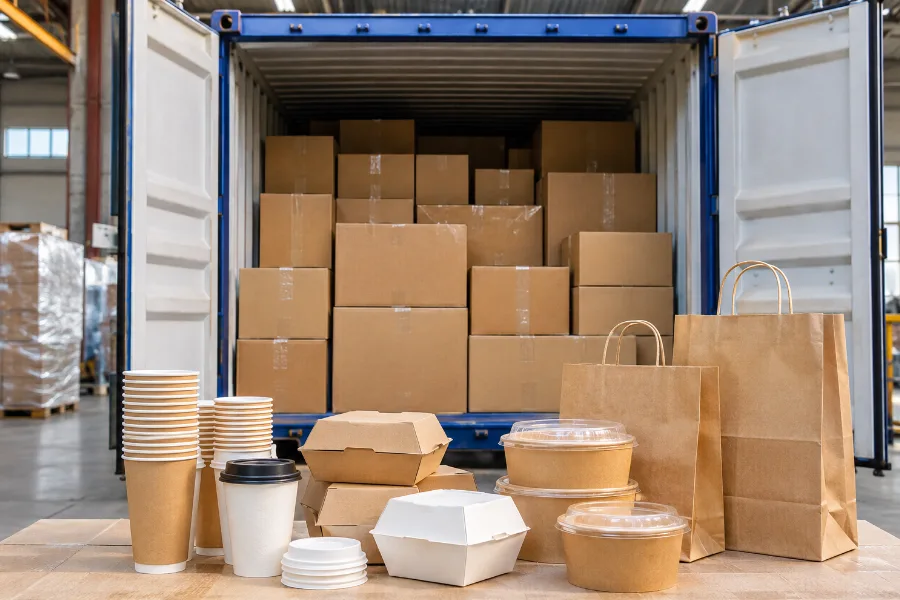
Ordering a full container of paper cups may make sense when you sell thousands of cartons every month. But what if your customers also need takeaway boxes, paper bowls, kraft paper bags, and matching lids?
Ordering a separate container for each product can create excess inventory, while shipping smaller quantities separately may increase freight and handling costs.
Mixed container loading allows wholesale food packaging importers to combine multiple products or SKUs in one shipment, provided their production quantities, carton specifications, and loading requirements are compatible.
The challenge is determining whether the products can share container space safely and economically. Importers need to evaluate carton volume, gross weight, stacking strength, supplier lead times, and total landed costs before confirming an order.
This guide explains how to plan a mixed shipment, calculate CBM, compare FCL and LCL, and allocate transportation costs across different food packaging products.
What Is Mixed Container Loading?
Mixed container loading means placing two or more different products or SKUs in the same shipping container.
A wholesale food packaging shipment might combine paper cups, matching lids, kraft takeaway bags, disposable food bowls, and folded paperboard lunch boxes.
Three shipping arrangements are relevant:
- Mixed-SKU FCL: One buyer books a dedicated container containing multiple products or SKUs.
- Multi-supplier consolidation: Products from different manufacturers are collected at a designated warehouse or loading point before being loaded into one container.
- LCL consolidation: A buyer ships a smaller quantity of goods in a container shared with cargo from other shippers.
FCL stands for full container load, while LCL means less than container load.
These arrangements are related but not interchangeable. A mixed-SKU FCL shipment can contain several product categories without involving multiple suppliers. Multi-supplier consolidation describes how cargo is collected, while FCL or LCL describes the shipping arrangement.
Combining products also does not automatically reduce the manufacturing minimum order quantity (MOQ) for each SKU. Custom printing, materials, production processes, and stock availability still determine individual order requirements.
When Does Mixed Container Loading Make Sense?
Mixed container loading is useful when an importer needs a broader product assortment than a single product order can justify.
Consider a restaurant supply distributor sourcing fast-food packaging for cafés, bakeries, and takeaway restaurants.
Its customers may purchase paper cups and takeaway boxes regularly but order smaller quantities of paper bags, food bowls, and specialty containers. Combining these products allows the distributor to allocate container space according to demand rather than purchasing full-container quantities of every item.
Balancing Inventory Across Multiple SKUs
Different packaging products rarely sell at identical rates.
A distributor might sell paper cups quickly while moving specialty bakery boxes more slowly. Ordering the same large quantity of both can create excess inventory and tie up working capital.
A mixed shipment allows buyers to allocate more space to fast-moving products and smaller quantities to slower-moving items. The decision should still account for individual MOQs, demand forecasts, and storage costs.
Introducing New Products
Importers can also use mixed shipments to test new product categories.
For example, a distributor already purchasing kraft paper bags might add a trial quantity of paper salad bowls to evaluate customer demand.
This works when the manufacturer accepts the requested production quantity and the additional cartons fit the loading plan. It is less practical when custom production requires a large MOQ or a significantly different production schedule.
Consolidating Products From Multiple Suppliers
When products come from different factories, consolidation can reduce the number of international shipping bookings.
However, the savings must be compared with factory-to-warehouse transportation, receiving, storage, and loading charges.
A supplier located far from the consolidation point may add enough domestic freight cost to offset the benefit of combining the products.
Quick Decision Guide: Mixed FCL, LCL, or Separate Shipments?
| Your Situation | Option to Evaluate First |
|---|---|
| Multiple SKUs with enough combined volume for a dedicated container | Mixed FCL |
| A small mixed order that does not justify a dedicated container | LCL |
| Products have incompatible production schedules | Separate shipments |
| Products come from several factories | Compare consolidation costs against separate shipping |
| An urgent product cannot wait for the remaining SKUs | Separate shipment for the urgent items |
The final decision should use comparable freight quotations, loading requirements, and delivery schedules. There is no universal CBM threshold at which FCL automatically becomes cheaper than LCL.
Which Food Packaging Products Can Share a Container?
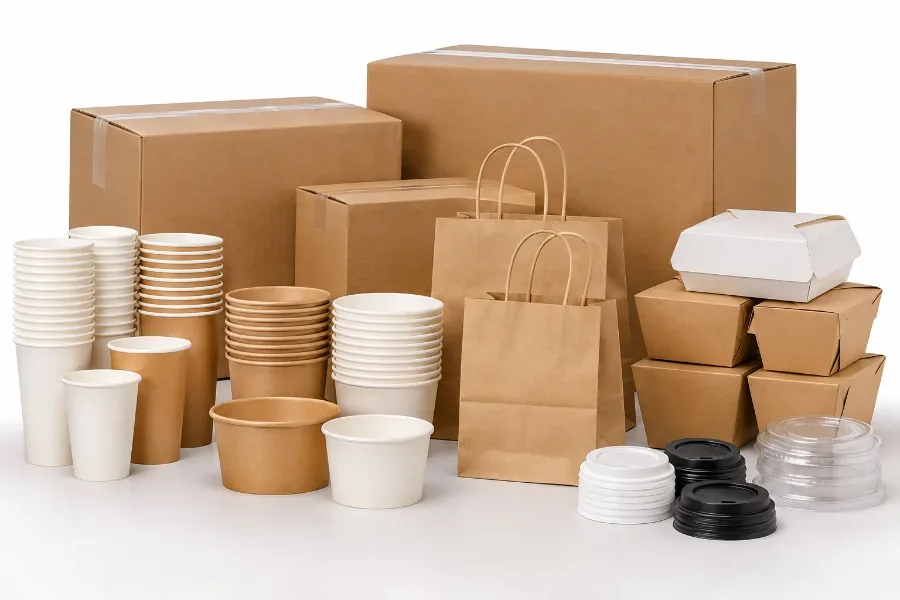
Many foodservice packaging products can travel together when their packaging, handling, and transportation requirements are compatible.
| Food Packaging Product | Typical Shipping Characteristics | Main Loading Considerations |
|---|---|---|
| Paper cups | Nested inside protective cartons | Prevent rim deformation and carton compression |
| Paper bowls | Nested or stacked | Protect rims and maintain lid compatibility |
| Kraft paper bags | Folded and packed in cartons | Control moisture exposure and compression |
| Paperboard takeaway boxes | Flat-packed or preformed | Check carton dimensions and stacking strength |
| Plastic food containers | Nested or stacked | Prevent crushing and product distortion |
| Disposable lids | Nested in cartons or sleeves | Protect shape and maintain size compatibility |
Paper Cups and Matching Lids
Paper cups and bowls are common products in mixed food packaging shipments. Matching lids should be ordered according to actual sales and usage patterns.
For example, ordering 100,000 cups and 50,000 lids may suit a distributor whose customers do not always use lids. It may be unsuitable for a business selling complete cup-and-lid sets.
Physical compatibility also matters. Cups and lids with similar nominal diameters are not necessarily interchangeable.
During loading, avoid placing heavy cartons on paper cup cartons unless their stacking strength has been verified. Excessive compression can distort cup rims and affect lid fit.
Kraft Paper Bags and Paperboard Food Boxes
Paper bags with handles and folded paperboard boxes can often be consolidated because both are packed into rectangular shipping cartons.
Their material properties still require different handling considerations. Paper bags and paperboard packaging can lose strength when exposed to excessive moisture, while inadequate carton protection can cause crushing during stacking.
Flat-packed paperboard food boxes can reduce transportation volume, but their outer cartons must remain sufficiently strong to protect the contents.
Before loading, inspect the container for leaks, visible moisture, and contamination.
Paper Bowls, Plastic Containers, and Other Products
Paper bowls, plastic takeaway containers, and disposable lids can also share a shipment when their packaging and handling requirements are compatible.
Do not stack heavy cartons of rigid containers above lightweight paper bowls simply because their dimensions fit. The carton compression limits and product deformation risks must also be considered.
Food-contact packaging should be protected from dust, odors, chemicals, and other potential sources of contamination during storage and transportation.
How to Plan a Mixed Container Load
A mixed container should be planned using confirmed carton specifications rather than estimated product dimensions.
The process involves four main stages: collecting SKU data, calculating volume, checking weight and stacking restrictions, and reviewing the physical loading arrangement.
Step 1: Prepare a Complete SKU and Carton List
Collect the following information for every product:
- Product name and SKU
- Units per carton
- External carton length, width, and height
- Gross weight per carton
- Total carton quantity
- Maximum recommended stacking layers, where available
- Special handling or protection requirements
Use external shipping carton dimensions rather than individual product dimensions. Freight calculations depend on the space occupied by the packed cartons.
Step 2: Calculate Carton Volume and Total CBM
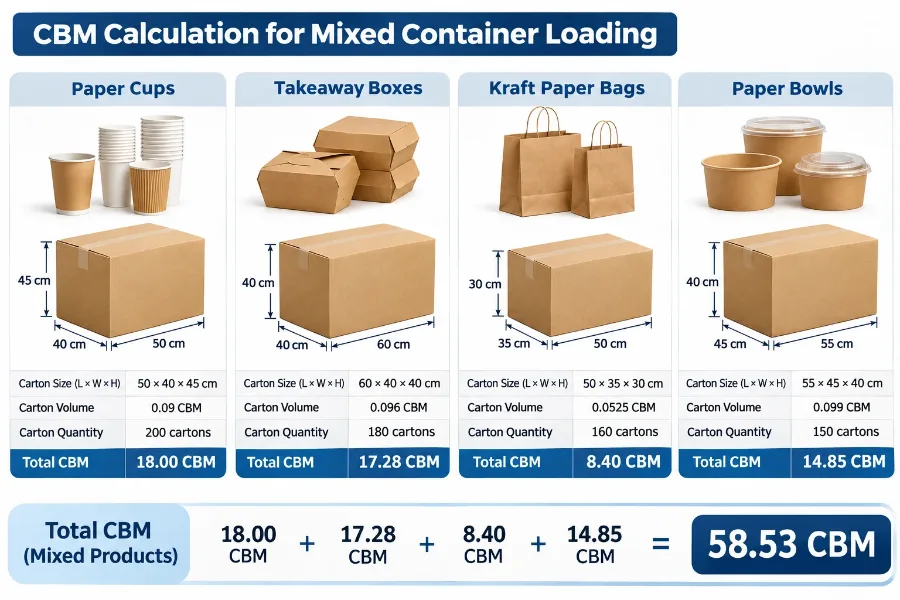
CBM is the standard trade abbreviation for cubic meter and is commonly used to measure cargo volume in international freight planning.
For rectangular cartons, use this formula:
CBM = Length × Width × Height × Carton Quantity ÷ 1,000,000
All carton dimensions must be measured in centimeters.
For example, a carton measuring 50 × 40 × 45 cm has a volume of:
50 × 40 × 45 ÷ 1,000,000 = 0.09 CBM
For 200 cartons:
0.09 × 200 = 18 CBM
The following hypothetical order illustrates how an importer can calculate the volume of a mixed food packaging shipment.
| Product | Outer Carton Dimensions (cm) | Cartons | Total CBM |
|---|---|---|---|
| Paper cups | 50 × 40 × 45 | 200 | 18.00 |
| Takeaway boxes | 60 × 40 × 40 | 180 | 17.28 |
| Kraft paper bags | 50 × 35 × 30 | 160 | 8.40 |
| Paper bowls | 55 × 45 × 40 | 150 | 14.85 |
| Total | 690 | 58.53 |
These dimensions and quantities are illustrative and do not represent actual ENTEN product specifications.
The combined external carton volume is 58.53 CBM. This figure provides a starting point for container selection, not proof that all cartons will physically fit.
Step 3: Check Gross Weight and Stacking Limits
Container capacity is restricted by both internal volume and maximum payload.
For disposable food packaging, bulky cartons may occupy most of the available space before reaching the container’s weight limit. However, heavier plastic products and accessories can change that calculation.
Check the following before confirming the loading plan:
- Total cargo gross weight, including cartons and pallets
- Container payload and applicable road weight restrictions
- Maximum stacking height for each carton
- Weight distribution across the container floor
- Door opening dimensions and loading equipment clearance
- Cargo securing and protection requirements
For example, a paper cup carton may have enough physical space above it for another layer, but its compression strength may not support the additional weight.
Use supplier-provided stacking limits or carton compression test data where available. Do not calculate stacking capacity from carton dimensions alone.
Step 4: Review the Actual Loading Layout
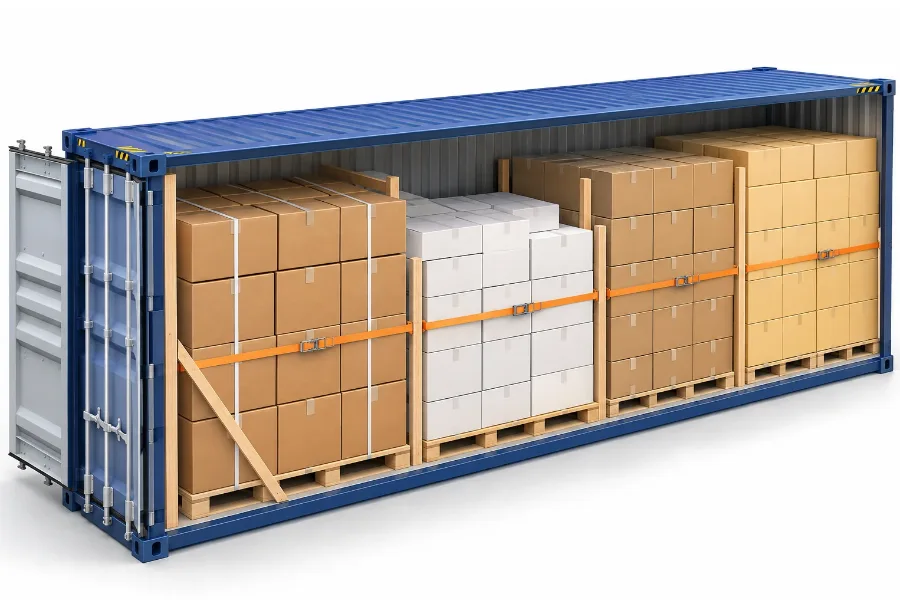
A container’s internal volume represents its geometric capacity, not the exact volume of cartons that can be loaded.
Suppose the hypothetical 58.53 CBM order is being considered for a 40HQ container with approximately 76.3 CBM of internal capacity.
The theoretical volume ratio is:
58.53 ÷ 76.3 × 100 = 76.7%
This means the cartons’ combined external volume equals approximately 76.7% of the container’s nominal internal volume. It does not represent a verified loading efficiency.
Actual loading capacity depends on carton dimensions, orientation, stacking strength, door clearance, pallets, and unused spaces between cartons.
The loading plan must also prevent cargo movement during transportation. Depending on the arrangement, blocking, bracing, or other suitable securing methods may be necessary.
For complex orders, request a scaled loading layout or container loading simulation that shows:
- Carton positions and orientations.
- Maximum stacking layers for each SKU.
- Weight distribution and floor loading.
- Space occupied by pallets and securing materials.
- The final position of each product group.
This helps identify space conflicts and potential carton damage before the container is loaded.
Choosing Between 20GP, 40GP, and 40HQ Containers
Food packaging importers commonly evaluate three dry-container types: 20-foot general purpose (20GP), 40-foot general purpose (40GP), and 40-foot high cube (40HQ).
| Container Type | Approximate Internal Volume | Typical Food Packaging Application |
|---|---|---|
| 20GP | 33.2 CBM | Smaller orders or relatively dense cargo |
| 40GP | 67.7 CBM | Larger mixed orders with standard stacking requirements |
| 40HQ | 76.3 CBM | Bulky, lightweight packaging that can use additional height |
These are representative specifications. Actual internal dimensions, payload, and usable space vary by equipment and carrier.
When a 20GP Container Makes Sense
A 20GP may suit a smaller assortment when total cargo volume is limited.
It can also be appropriate for relatively dense cargo that reaches weight restrictions before requiring the space of a larger container.
Compare complete freight quotations before choosing. A smaller container does not automatically provide a lower freight cost per carton.
When a 40GP or 40HQ Container Makes Sense
A 40GP provides substantially more internal volume than a 20GP, making it suitable for larger mixed orders.
A 40HQ offers additional internal height, which can benefit bulky, lightweight packaging when cartons can be stacked safely.
However, if paper cup cartons cannot support additional layers, the extra height may provide little practical benefit.
Select the container according to the complete cargo profile, including carton dimensions, weight, stacking restrictions, and loading arrangement.
Mixed FCL vs. LCL vs. Separate Shipments
The appropriate shipping arrangement depends on order volume, supplier locations, production schedules, and destination charges.
| Factor | Mixed FCL | LCL | Separate Shipments |
|---|---|---|---|
| Cargo arrangement | Multiple SKUs in one dedicated container | Cargo shared with other shippers | Products travel in separate bookings |
| Suitable order | Sufficient combined volume for FCL | Smaller combined volume | Different schedules or origins |
| Freight pricing | Usually quoted per container, plus applicable charges | Based on chargeable volume or weight and service terms | Calculated separately |
| Handling | Dedicated container handling | Consolidation and deconsolidation | Depends on each shipment |
| Scheduling | Products generally depart together | Depends on consolidation schedules | Products can ship independently |
| Main trade-off | Requires coordinated supply and loading | Shared handling and destination charges | More separate bookings and potentially higher costs |
Mixed FCL
Mixed FCL is worth evaluating when the combined order justifies a dedicated container.
It provides greater control over product arrangement and cargo securing. However, products from multiple factories may require additional domestic transportation and warehouse handling.
LCL Shipping
LCL suits smaller orders that do not justify booking a complete container.
The buyer pays for space in a shared container, but the cargo may undergo additional handling at consolidation and destination facilities.
For cartons sensitive to crushing or deformation, confirm how the goods will be protected during these handling stages.
Separate Shipments
Separate shipments may be preferable when products have incompatible production schedules or originate from distant supplier locations.
For example, waiting several weeks for custom-printed paper bags could delay an otherwise ready shipment of standard paper cups.
Shipping the paper cups separately may cost more in freight but prevent a stockout or missed delivery commitment.
Compare quotations for the same destination, cargo specifications, and delivery requirements rather than relying on a general FCL-versus-LCL volume threshold.
How Mixed Loading Affects Your Landed Cost
A mixed container may reduce the number of international freight bookings, but additional consolidation expenses can offset the savings.
Importers should compare the total landed cost of the products under different shipping arrangements.
Costs to Include in the Comparison
Depending on the Incoterm and destination, the comparison may include:
- Product purchase costs
- Domestic transportation from factories to the loading point
- Consolidation warehouse and handling charges
- Container loading and cargo protection
- Ocean freight and applicable insurance
- Destination terminal and documentation charges
- Customs clearance, duties, and taxes
- Inland delivery to the importer’s warehouse
- Potential storage, delay, and damage costs
For example, combining paper cups and paper bags from two suppliers may appear economical if their cargo uses a substantial portion of a 40HQ container.
However, if the factories are far apart, transportation to a shared loading point could increase the total cost enough to reduce the benefit of consolidation.
How to Allocate Freight Costs Across SKUs
Importers need a consistent method for distributing shared logistics expenses among products.
| Allocation Method | How It Works | Main Consideration |
|---|---|---|
| By CBM | Allocate shared costs according to each SKU’s share of total cargo volume | Useful for bulky packaging but may not reflect weight-driven costs |
| By gross weight | Allocate costs according to each SKU’s share of shipment weight | Suitable when weight drives the relevant charge |
| By cargo value | Allocate costs according to each SKU’s share of purchase value | May suit value-related costs but not physical freight usage |
Consider the hypothetical order containing 58.53 CBM of mixed food packaging.
The paper cups occupy 18 CBM, giving them a volume share of:
18 ÷ 58.53 × 100 = 30.75%
If the importer allocates $4,000 in shared freight costs according to CBM, the paper cups receive:
$4,000 × 30.75% = $1,230
The same method can be applied to the other products.
| Product | Total CBM | Share of Total Volume | Allocated Freight Cost |
|---|---|---|---|
| Paper cups | 18.00 | 30.75% | $1,230 |
| Takeaway boxes | 17.28 | 29.52% | $1,181 |
| Kraft paper bags | 8.40 | 14.35% | $574 |
| Paper bowls | 14.85 | 25.37% | $1,015 |
| Total | 58.53 | 100% | $4,000 |
The figures are illustrative and represent an accounting allocation, not a freight quotation. Percentages may not total exactly 100% because of rounding.
For 200 cartons of paper cups, the allocated freight cost is:
$1,230 ÷ 200 = $6.15 per carton
This gives the importer a basis for comparing supplier quotations and estimating the delivered cost of each product.
Different cost categories require appropriate allocation methods. Customs duties, for example, should be calculated using applicable tariff classifications, customs valuation, origin rules, and destination-country requirements rather than automatically distributed by CBM.
Common Challenges for Food Packaging Importers
Mixed loading introduces several coordination and cargo-protection risks.
| Challenge | Why It Matters | Recommended Action |
|---|---|---|
| Different MOQs | Each SKU has separate production requirements | Confirm individual minimum quantities |
| Different lead times | One delayed product can hold up the shipment | Establish production deadlines and a consolidation cutoff |
| Moisture exposure | Paper packaging can lose strength | Inspect containers and arrange suitable moisture protection |
| Carton compression | Excessive stacking can deform products | Confirm carton strength and stacking limits |
| Multiple suppliers | Products may arrive at different times or locations | Coordinate delivery and consolidation responsibilities |
| Documentation differences | Products may have different classifications or import requirements | Confirm documents and customs requirements before shipment |
Different Production Lead Times
Products in a mixed container need to meet a coordinated shipping schedule.
If one product is delayed, the importer may need to store the other goods or revise the shipment.
Confirm production readiness dates and agree on a final delivery cutoff for the consolidation warehouse. If an urgent product cannot wait, compare the cost of shipping it separately against the risk of a stockout.
Moisture and Compression Damage
Paper-based packaging can lose strength when exposed to excessive moisture. Container condensation, leaks, and poor storage conditions can increase this risk.
Inspect the container before loading and check carton strength, stacking arrangements, and suitable moisture protection.
Desiccants or protective liners may be appropriate depending on the cargo and transportation conditions, but they should not be treated as guaranteed protection.
Coordination Between Multiple Suppliers
Multi-supplier consolidation requires clear responsibility for transportation, receiving, inspection, and loading.
Agree in advance on the consolidation location, delivery schedule, carton labeling, loading responsibility, and handling charges.
Customs and Documentation
Products in one container may have different customs classifications, origins, and regulatory requirements.
For example, a shipment combining paper food containers and plastic lids may require separate product descriptions and tariff classifications.
Food-contact packaging may also be subject to destination-market requirements. Confirm product compliance and documentation with the freight forwarder or customs broker before shipment.
How to Prepare a Mixed Container RFQ
A well-prepared request for quotation gives suppliers the information needed to evaluate product costs, production requirements, and shipment arrangements.
| Required Information | What to Provide | Why It Matters |
|---|---|---|
| Product list | Product names and SKU codes | Identifies the complete assortment |
| Specifications | Material, dimensions, capacity, and applicable lid size | Confirms the correct products |
| Order quantity | Units and cartons required per SKU | Supports production planning |
| Carton details | Outer dimensions, units per carton, and gross weight | Determines volume and weight |
| Customization | Printing, colors, artwork, and packaging requirements | Affects MOQ and production schedule |
| Destination | Destination port and final delivery location | Supports freight planning |
| Shipping schedule | Required shipment or arrival window | Helps coordinate production |
| Trade terms | Requested Incoterm and named place or port | Clarifies pricing responsibilities |
| Special requirements | Palletization, stacking, protection, and required documents | Identifies loading and compliance constraints |
If exact carton specifications are unavailable, request them from each supplier before finalizing the shipment.
Also confirm whether the quotation includes consolidation, loading, cargo protection, and export documentation. These services should not be assumed to be included automatically.
Pre-Shipment Mixed Container Checklist
Before dispatch, confirm that:
-
Individual SKUs, quantities, and production readiness dates are confirmed.
-
Final carton dimensions, gross weights, and stacking limits are available.
-
The selected container and loading arrangement have been approved.
-
Cargo securing and moisture protection requirements have been addressed.
-
Supplier delivery and consolidation responsibilities are agreed.
-
Shipping documents and destination import requirements have been reviewed.
-
Freight, handling, customs, and delivery cost estimates have been compared.
This final check should use confirmed product and shipment information, not preliminary estimates.
Request a Packaging Quote
If you are sourcing paper cups, takeaway boxes, paper bags, or other foodservice packaging, prepare your product list, estimated quantities, specifications, and destination details before requesting a quotation.
ENTEN can help you discuss your food packaging requirements and evaluate suitable product options for your purchasing plans.
Frequently Asked Questions
Can I Mix Paper Cups, Food Boxes, and Paper Bags in One Container?
Yes. These products can often be combined when their carton dimensions, stacking strength, and handling requirements are compatible. The loading plan should also address moisture protection and cargo securing.
Does Mixed Container Loading Reduce the MOQ for Each Product?
Not necessarily. Mixed loading allows several SKUs to share container space, but manufacturing MOQs are determined separately by product specifications, customization, production processes, and stock availability.
Is Mixed FCL Cheaper Than LCL?
Mixed FCL can offer a lower freight cost per carton when the combined order uses enough container capacity. LCL may be more economical for smaller shipments. Compare origin, ocean freight, destination, and delivery charges before choosing.
How Do I Calculate CBM for a Mixed Food Packaging Order?
Multiply each carton’s external length, width, and height in centimeters, divide by 1,000,000, and multiply by the number of cartons. Repeat the calculation for every SKU and add the results. Total CBM is a planning input, not a guarantee that the cartons will physically fit.
Can Products From Different Suppliers Be Loaded Into One Container?
Yes, provided the suppliers can coordinate delivery to a suitable consolidation point and the cargo is compatible. Confirm transportation costs, warehouse handling, production schedules, documentation responsibilities, and loading arrangements before committing to the shipment.
Technical References
Container capacity figures are based on representative Hapag-Lloyd equipment specifications. Cargo packing recommendations are informed by the IMO/ILO/UNECE CTU Code. Actual container dimensions, permitted payloads, and loading conditions must be confirmed for each shipment.
All carton dimensions, order quantities, and freight costs used in the calculation examples are hypothetical and are provided for educational purposes only.