

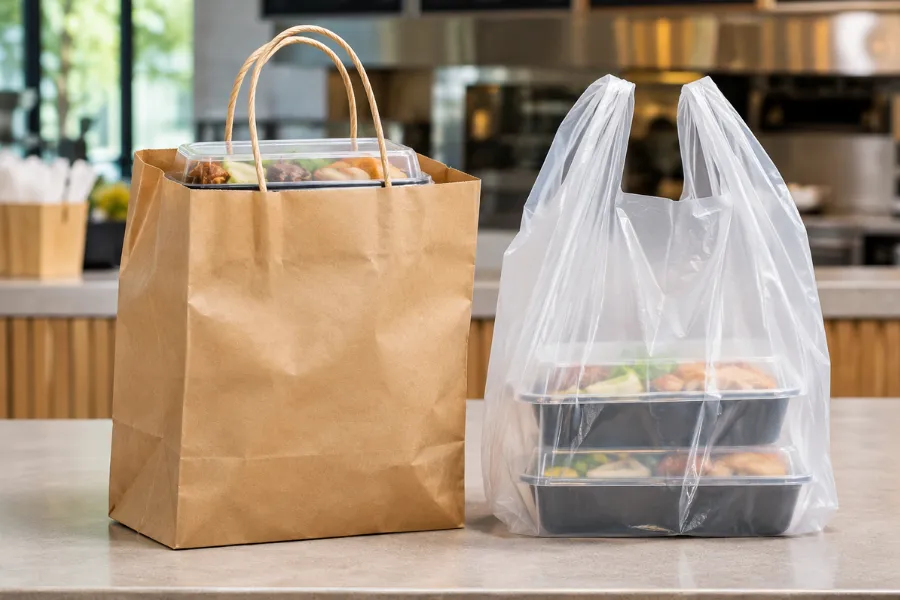
Paper takeout bags are often better suited to dry, boxed meals that benefit from a stable, flat-bottom carrier. Plastic takeout bags generally resist liquid water and condensation more effectively, making them useful for certain beverage orders and moisture-prone deliveries.
Neither material is universally stronger, cheaper per completed order, or environmentally preferable. Restaurants should compare finished bag construction, container fit, loaded weight, moisture exposure, delivery conditions, and local carryout bag regulations before purchasing.
Paper vs. Plastic Takeout Bags at a Glance
| Comparison Factor | Paper Takeout Bags | Plastic Takeout Bags |
|---|---|---|
| Common materials | Kraft paper, white paper, and treated paper | HDPE, LDPE, and other plastic films |
| Carrying strength | Influenced by fiber properties, basis weight, bottom construction, and handles | Influenced by film formulation, thickness, seams, and handles |
| Moisture resistance | Untreated paper absorbs water and may lose strength | Generally resists incidental liquid-water exposure |
| Grease resistance | Ordinary kraft paper has limited resistance without suitable treatment | Polyethylene films generally resist incidental oil and grease contact |
| Hot food delivery | Can absorb condensation; performance depends on treatment and construction | Resists moisture but can retain humid air when closed |
| Container stability | Flat-bottom designs can support upright packing | Flexible bags conform to containers but may need additional support |
| Storage | Folded bags may occupy more storage space | Thin-film bags are generally compact |
| Custom printing | Suitable for branding on kraft or white paper | Suitable for printing with processes designed for flexible films |
| Initial cost | Often higher for basic comparable applications | Basic thin-film bags are often less expensive |
| Recycling | Depends on coatings, contamination, and local collection | Often requires separate film collection where available |
These comparisons assume bags designed for similar carrying functions.
A reinforced paper bag may carry several boxed meals reliably when dry, while a thin plastic bag may resist condensation but tear when a sharp container corner concentrates stress against the film.
For purchasing decisions, compare finished bags carrying the same representative order rather than comparing material names alone.
Paper vs. Plastic Bag Strength, Moisture, and Heat Resistance
Strength and Carrying Capacity
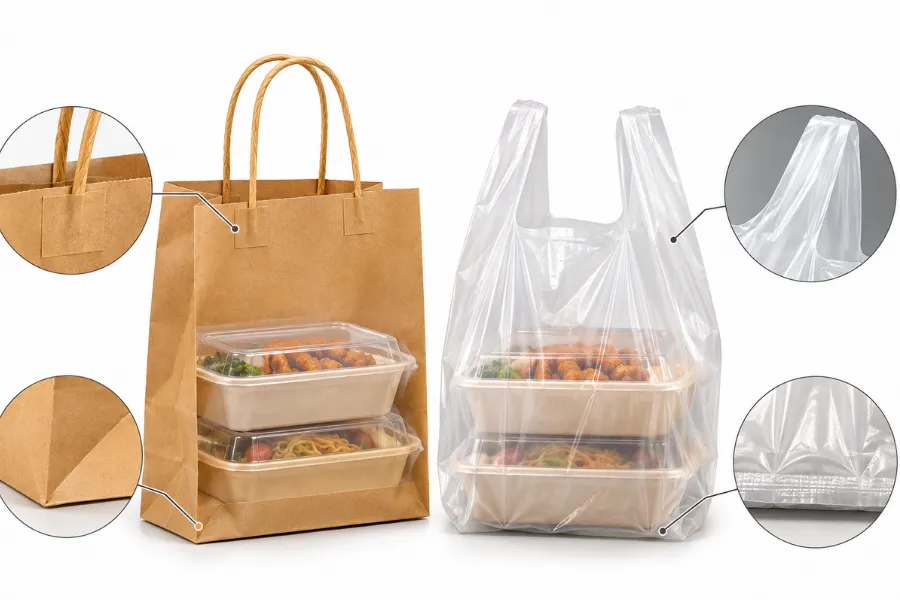
Kraft paper is commonly manufactured using chemical pulping processes that preserve relatively strong cellulose fibers. Its suitability for packaging depends on fiber properties, paper manufacture, and the construction of the finished bag.
Six factors influence paper takeout bag strength:
- Paper basis weight: Higher basis weight generally means more material per unit area, but it does not independently establish carrying capacity.
- Fiber orientation: Paper may have different strength properties in the machine and cross directions, influencing its response to loading and tearing.
- Bottom construction: Folded panels and adhesive bonds must withstand the weight concentrated beneath food containers.
- Handle attachment: Twisted handles, flat handles, and reinforced attachment areas distribute carrying forces differently. Buyers comparing paper bags with handles should inspect the attachment method as well as the handle itself.
- Bag dimensions: Containers that shift inside oversized bags can create uneven loading and reduce stability.
- Moisture exposure: Water absorption can weaken paper fibers and affect bonded areas.
Potential failure points include bottom folds, glued seams, and handle attachments, particularly when the bag is overloaded or exposed to moisture.
For example, a paper bag carrying two sealed meal containers may remain stable during pickup. If a cold beverage produces condensation that collects beneath the containers, the bottom panel may soften during a longer delivery.
Plastic bag performance depends on a different set of variables.
High-density polyethylene (HDPE) is commonly used for lightweight T-shirt-style carrier bags. Low-density polyethylene (LDPE) is often more flexible and appears in various soft-film packaging applications.
However, polymer type alone does not determine finished-bag strength.
Film thickness, resin formulation, processing conditions, seams, and handle geometry influence how the bag responds to loading. Sharp container corners may concentrate stress, causing punctures or tears even when the film resists moisture.
For heavy takeout orders, compare the finished bags’ loaded performance, including handle integrity, bottom deformation, and resistance to container movement.
Moisture, Grease, and Condensation
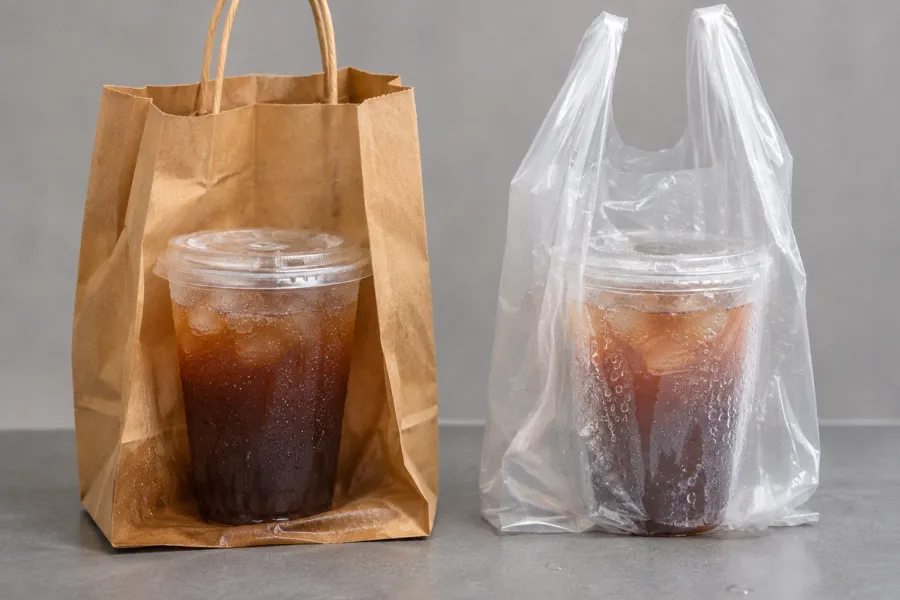
Untreated paper absorbs water through its cellulose fiber structure. This can reduce mechanical strength, particularly where moisture reaches folds or adhesive bonds.
Paper treatments can improve specific properties, but three forms of resistance must be distinguished:
| Property | What It Measures | Why Restaurants Should Care |
|---|---|---|
| Water resistance | Response to contact with liquid water | Condensation beneath cups or containers |
| Grease resistance | Resistance to oil and fat penetration | Oily baked goods, fried foods, and grease transfer |
| Water vapor barrier performance | Rate of water vapor transmission | Moisture movement through packaging materials |
Sizing can reduce the rate at which liquid water penetrates paper. Suitable coatings may provide additional protection, depending on their composition, coverage, and intended use.
Greaseproof paper is manufactured to resist oil and fat penetration under specified conditions. Ordinary kraft paper does not automatically provide equivalent performance.
For oily pastries or certain fried foods, greaseproof paper bags may be worth evaluating alongside appropriate food containers and wraps.
However, grease resistance does not establish liquid-water resistance, and neither property guarantees that a finished bag is leakproof.
Polyethylene films generally resist incidental liquid-water contact more effectively than untreated paper. Their gas and water vapor permeability still depends on polymer composition, thickness, temperature, and exposure conditions.
A plastic carrier may therefore remain intact when exposed to condensation while allowing humid air to accumulate around its contents.
The primary food container should provide the necessary protection against sauces, oils, and liquid leakage. The outer bag should be selected for carrying stability and the moisture conditions it is likely to encounter.
Heat, Steam, and Food Delivery Conditions
Hot meals release water vapor. When warm, humid air contacts a cooler surface, condensation can form on food containers or inside the carrying bag.
In a tightly closed plastic bag, humid air may remain around the containers. Untreated paper may allow more moisture exchange, but it can also absorb the resulting condensation.
The effect on food quality depends largely on the primary container.
For example:
- Fried chicken: Ventilation can help release steam that would otherwise soften a crisp coating.
- Rice and cooked meals: Containers must balance heat retention with appropriate moisture management.
- Soups: Secure lids and leak-resistant container construction are more important than the carrier bag’s moisture resistance.
- Hot beverages: Suitable lids and stable cup carriers help prevent tipping and spills.
Ventilation and insulation involve a tradeoff. Releasing steam may help preserve texture but can also increase heat loss.
Restaurants should therefore evaluate containers, ventilation, insulation, and outer bags together. Comparing fast food packaging solutions can help buyers identify suitable components for different menu items.
Food temperature during delivery also depends on the initial food temperature, container construction, holding time, and insulated transport equipment. A paper or plastic carrier bag alone should not be relied upon for temperature control.
Which Takeout Bags Work Best for Different Restaurant Orders?
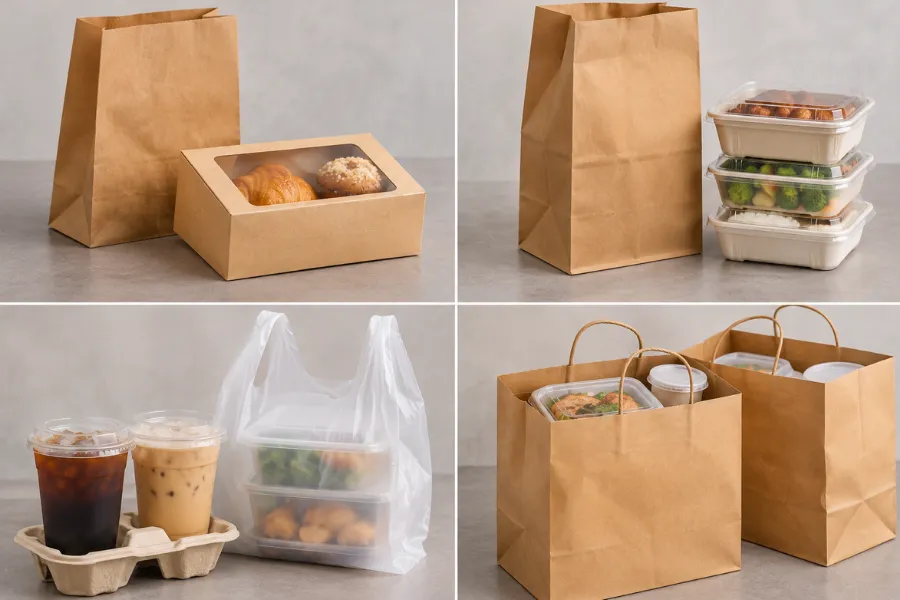
The most useful way to select a takeout bag is to start with the containers and conditions associated with the order.
| Restaurant Order | Suggested Bag | Main Selection Reason | Risk to Test |
|---|---|---|---|
| Bread and dry bakery products | Kraft paper bag | Stable packing and presentation | Bag dimensions and moisture exposure |
| Boxed hot meals | Flat-bottom paper bag or suitable plastic carrier | Supports grouped containers | Condensation and shifting |
| Soup and sauce-heavy orders | Moisture-resistant carrier with sealed containers | Tolerates incidental liquid exposure | Lid leakage and container stability |
| Cold drinks and desserts | Moisture-resistant carrier or suitable cup-carrying system | Manages condensation exposure | Cup tipping and wet bag bottoms |
| Large family meals | Reinforced bag or multiple smaller bags | Distributes carrying loads | Handle and bottom failure |
| Delivery orders | Bag matched to the container combination | Supports transport and handoff | Movement, moisture, and local restrictions |
Bakery and Café Orders
Bakeries and cafés frequently use paper bags for bread, pastry boxes, and other relatively dry products. Flat-bottom designs can help staff pack rectangular containers without holding the bag open continuously.
When selecting packaging for desserts and pastries, buyers should evaluate the primary package and outer carrier as a combined system.
For example, a pastry box that fits closely within a paper bag may remain upright during pickup. An oversized carrier can allow the box to slide or tilt.
Cold beverages require separate consideration.
Condensation forms when humid air contacts a sufficiently cold cup. If water collects against untreated paper, the bag bottom may weaken during holding or delivery.
A café offering both boxed pastries and iced drinks may therefore need separate bag formats or an appropriate cup carrier rather than one universal bag.
Hot Meals and Takeout Delivery
Flat-bottom paper bags can support boxed meals when their base dimensions closely match the containers.
SOS paper bags are one option for operations that need self-opening, flat-bottom bags that can stand during order preparation.
Container fit matters in two directions.
A container that is too large can distort the bag walls and bottom folds. A container that is much smaller than the bag base can move during transport.
Stacking containers may reduce the required bag footprint, but the lower containers must be designed to support the weight above them.
For hot-food deliveries, inspect the packed bag after a representative holding period. Condensation-related weakening or container movement may not be visible immediately after packing.
Soup, Sauces, and Beverage Orders
Soup containers need secure lids and suitable sealing performance before the outer bag is considered.
A moisture-resistant carrier can tolerate some incidental liquid exposure, but it cannot prevent a poorly closed container from spilling.
Cold drinks introduce another problem: cup stability.
A flexible plastic bag may resist condensation while allowing an unsupported cup to tilt. A structured paper bag may support a separate cup carrier but remain vulnerable if water accumulates at the bottom.
For mixed beverage and meal orders, test whether the cup carrier and food containers can remain stable together. If not, separating the beverages may be more reliable than increasing bag size.
Large Family Meals and Catering Orders
Large orders concentrate weight across several containers, often with different dimensions.
An oversized bag can be difficult to carry if its handles and bottom are not designed for the combined load.
Dividing the order into two bags may reduce stress on individual handles and simplify transport, although it increases the number of bags used.
The decision should account for total packed weight, container stacking, handle construction, and how the order will be carried.
Compare one-bag and multiple-bag arrangements with the same representative order before standardizing the packing method.
Environmental Impact of Paper vs. Plastic Takeout Bags
Environmental comparisons must account for material production, bag weight, carrying function, transportation, and end-of-life conditions.
A renewable raw material does not automatically produce the lowest life-cycle impact, and a lightweight bag is not automatically environmentally preferable.
Raw Materials and Production
Paper is produced from plant-derived fibers, commonly wood pulp. Its environmental impacts depend on forestry practices, pulping methods, energy sources, water use, and manufacturing efficiency.
Kraft paper is commonly produced from chemical pulp and may be used unbleached for packaging applications.
Plastic takeout bags frequently use polyethylene manufactured from fossil-derived feedstocks, although alternative feedstock routes also exist.
Thin plastic films can provide carrying functions with relatively low material weight. This may reduce packaging mass and influence transportation requirements.
Paper bags may require more material by weight for a comparable carrying function, while paper manufacturing can involve substantial pulping and drying energy.
However, production-stage comparisons alone do not account for reuse, litter, recycling, or other end-of-life effects.
These differences make it important to compare specific bag designs rather than assuming that either material has a universally lower impact.
Recycling and Compostability
Paper and plastic bags require different recovery systems.
Paper recycling typically involves repulping and separating usable fibers from contaminants. Clean paper bags may be accepted in local paper recycling programs, but coatings, attached components, and food contamination can affect acceptance.
Plastic film recycling requires appropriate collection, sorting, and processing.
Loose plastic bags are not accepted in many curbside recycling systems because flexible films can interfere with sorting equipment. Separate film collection may be available, depending on the location and material.
A product being technically recyclable does not guarantee that it can be recycled through the customer’s available collection system.
Compostability requires similar qualification.
Uncoated paper may break down under suitable biological conditions, but coatings, inks, adhesives, and other components can affect the compostability of the finished bag.
Conventional polyethylene bags are not generally compostable.
Some specialty bags use compostable polymers, including formulations containing bio-based materials. These terms describe different properties:
- Bio-based: Made partly or entirely from biological feedstocks.
- Biodegradable: Capable of biological breakdown under specified conditions.
- Compostable: Able to meet defined composting requirements under relevant conditions.
Bio-based materials are not automatically compostable, and biodegradable materials are not necessarily suitable for home composting.
Before purchasing bags marketed as compostable, request documentation for the finished product and confirm acceptance by the intended composting facility.
Why Life Cycle Assessment Matters
Life cycle assessment (LCA) examines environmental impacts across defined stages of a product’s life. ISO 14040 and ISO 14044 provide established frameworks for conducting LCA studies.
A meaningful paper-versus-plastic comparison requires a consistent functional unit.
For restaurants, that could mean the number and type of bags needed to carry 1,000 specified takeout orders safely, rather than simply comparing one paper bag with one plastic bag.
Relevant variables include:
- Material composition and manufacturing energy.
- Bag weight and carrying capacity.
- Number of bags required per order.
- Transportation distance and packaging volume.
- Reuse assumptions.
- Local recycling and disposal pathways.
- Environmental leakage and litter.
- The environmental impact categories being measured.
Some comparative studies of grocery shopping bags have reported higher production-stage impacts for paper alternatives under particular assumptions.
However, grocery bags and restaurant takeout bags may differ in construction, load requirements, moisture exposure, reuse patterns, and disposal conditions. Results from one application should not be transferred directly to another without evaluating those differences.
Restaurants making environmental purchasing claims should therefore rely on documented attributes of the specific bags being considered, such as verified recycled content, material reduction, or applicable compostability certification.
Cost Comparison of Paper vs. Plastic Takeout Bags
Basic thin-film plastic bags often have lower initial unit prices than paper bags intended for similar everyday carrying applications.
However, the purchasing comparison changes when bag dimensions, carrying capacity, printing, delivery costs, and the number of bags required per order are considered.
What Affects Takeout Bag Prices?
| Cost Factor | What Buyers Should Compare |
|---|---|
| Material | Paper grade and basis weight, or plastic resin and film thickness |
| Dimensions | Finished width, depth, height, and usable capacity |
| Construction | Handles, reinforcement, seams, and bottom design |
| Printing | Number of colors, artwork requirements, and setup costs |
| Order quantity | MOQ, case quantity, and volume-based pricing |
| Logistics | Freight, storage requirements, and purchasing frequency |
Quotations should describe bags intended to carry equivalent orders.
Comparing a small handleless paper bag with a large reinforced plastic carrier would not provide a useful cost benchmark.
Example: Monthly and Annual Bag Costs
Consider a restaurant using 2,000 takeout bags per month.
Assume the following illustrative unit prices:
- Paper bag: $0.15.
- Plastic bag: $0.04.
- One bag per order.
- Consistent monthly order volume.
| Cost Measure | Paper Bags | Plastic Bags |
|---|---|---|
| Illustrative unit price | $0.15 | $0.04 |
| Monthly quantity | 2,000 | 2,000 |
| Monthly purchase cost | $300 | $80 |
| Annual purchase cost | $3,600 | $960 |
Annual bag cost = Unit price × Monthly bag quantity × 12
Annual cost difference = $3,600 − $960 = $2,640
The paper bag option costs $2,640 more annually under these assumptions.
These are illustrative prices, not verified market averages or ENTEN quotations.
The calculation excludes freight, printing setup, storage, damage, additional packaging, and applicable regulatory charges.
Compare Cost Per Packed Order
Unit price can be misleading when different bag types require different packing arrangements.
For example, if a heavy meal requires two lightweight bags but fits safely in one reinforced carrier, the correct comparison is the total bag cost for that order.
Effective bag cost per order = Total bag purchasing and handling costs ÷ Number of orders packed
When calculating this figure, include:
- Additional bags used for double-bagging.
- Replacement bags after damage.
- Packaging waste caused by unsuitable sizes.
- Freight and storage costs.
- Other handling expenses that can be measured reliably.
Restaurants may reduce unnecessary packaging costs by standardizing a small range of bag sizes matched to their most common order configurations.
Branding and Customization Options
Paper and plastic bags differ in surface characteristics, printing requirements, and construction options.
Kraft paper provides a fibrous printing surface, while white paper offers a lighter background for printed artwork. Ink absorption and the paper surface can influence the appearance of colors and fine details.
Plastic films require printing processes and ink systems compatible with flexible polymer surfaces. Film properties and surface treatment can affect ink adhesion and print quality.
Restaurants requesting custom takeout bags should specify the finished product rather than selecting a material based only on appearance.
Common Customization Options
| Specification | Paper Bag Considerations | Plastic Bag Considerations |
|---|---|---|
| Material | Kraft or white paper, basis weight, treatments | Resin type, film thickness, formulation |
| Dimensions | Width, depth, height, and bottom footprint | Width, length, gussets, and usable opening |
| Handles | Twisted, flat, or other attached handle designs | Integrated, die-cut, or other suitable designs |
| Printing | Paper surface, artwork, and color requirements | Film compatibility, printing method, and colors |
| Construction | Folded bottom, seams, reinforcement | Film seals, gussets, and handle geometry |
| Additional features | Suitable closures or specialty treatments | Suitable closures or other available features |
Availability depends on the bag design and production process.
A twisted paper handle and an integrated T-shirt-style plastic handle, for example, use different load-bearing structures and should be evaluated separately.
Before approving a custom order, confirm the finished dimensions, material specifications, printing proof, sample construction, and packing requirements.
How to Choose and Test Takeout Bags Before Bulk Ordering
A useful sample evaluation should represent actual restaurant operations rather than testing an empty bag.
Select two or three common order configurations, including a heavier or more moisture-prone order, and compare candidate bags under similar conditions.
1. Match Bag Dimensions to Your Containers
Measure the outside length, width, and height of the food containers, including lids and projecting features.
For flat-bottom paper bags, compare container dimensions with the usable bottom footprint and bag opening.
For plastic bags, check the opening, gussets, and available space after the bag is loaded.
The container should fit without forcing the bag walls outward or leaving excessive room for movement.
For stacked orders, include the total stack height and confirm that the bag can be carried without pressing against container lids.
2. Test Carrying Strength With Real Orders
Pack the bag with the same containers, utensils, napkins, and beverages used in service.
Lift it by the intended handles and carry it over a representative distance.
Inspect:
- Handle stretching, loosening, or tearing.
- Bottom deformation.
- Container movement or tilting.
- Stress around sharp container corners.
- Stability when the bag is placed on a surface.
Repeat the evaluation with the heavier orders the restaurant expects to pack.
For paper bags, inspect bottom folds, glued seams, and handle attachments. For plastic bags, inspect film seams, handles, and areas pressed against container edges.
These checks are practical sample evaluations, not standardized laboratory carrying-capacity tests.
3. Test Moisture and Condensation Exposure
Use actual sealed hot-food or cold-beverage containers during a holding period representative of pickup or delivery.
For cold drinks, check whether condensation collects beneath the cups or reaches paper folds.
For hot meals, inspect the bag and containers for accumulated condensation after the expected holding interval.
Record whether moisture causes:
- Softening of paper.
- Changes in handle or bottom integrity.
- Visible deformation.
- Unstable container placement.
- Excessive moisture accumulation inside the bag.
Water vapor transmission and oxygen transmission tests measure material barrier properties. They do not independently establish the carrying strength of a finished bag after liquid-water exposure.
If a supplier provides laboratory results, confirm the test method, sample construction, and property measured.
4. Simulate Normal Delivery Handling
Evaluate the bag through the same handling sequence used by staff and delivery drivers:
- Pack the order.
- Place it on a pickup shelf.
- Lift and transfer it into a delivery carrier.
- Transport it under representative conditions.
- Remove and hand it to the customer.
Check for container shifting, bag deformation, and damage at the handles or bottom.
For large orders, compare one-bag and multiple-bag configurations using the same containers and total weight.
A simple evaluation record should identify the bag specification, packed weight, holding conditions, observed problems, and whether the configuration passed the restaurant’s practical requirements.
5. Verify Supplier Specifications and Compliance
After selecting a suitable sample, confirm that the quoted bulk product matches the tested construction.
| Specification | What to Confirm |
|---|---|
| Bag dimensions | Finished width, depth, height, and tolerances |
| Material | Paper grade or plastic film composition |
| Material weight | Paper basis weight or film thickness |
| Construction | Bottom design, seams, and handle attachments |
| Intended use | Suitable carrying conditions and limitations |
| Printing | Artwork, printing method, and colors |
| Order quantity | MOQ, case quantity, and available sizes |
| Delivery | Production schedule, packing, and freight terms |
| Environmental claims | Supporting documentation for recycled content or compostability |
| Food contact | Appropriate documentation if direct food contact is intended |
Most restaurant takeout bags are secondary carriers for food already enclosed in suitable containers or wraps.
If a bag will directly contact unwrapped food, confirm that the finished material and relevant components are suitable for the intended food types, temperatures, and contact conditions.
Check Local Carryout Bag Regulations
Local bag regulations can affect permitted materials, minimum construction requirements, recycled content, labeling, and customer charges.
For example, Washington state restricts certain single-use plastic carryout bags and establishes requirements for qualifying paper and reusable plastic film bags.
Under its 2026 rules, qualifying large paper carryout bags generally carry an 8-cent charge, while qualifying reusable plastic film bags have applicable minimum charges and construction requirements.
Certain reusable plastic film bags at least 4 mil thick are subject to an additional 4-cent charge during 2026–2027.
Qualifying bags must also meet applicable recycled-content or other material requirements and labeling provisions. Exemptions and bag-category distinctions apply.
Restaurants should not assume that every paper bag is subject to the same charge or that an ordinary thin plastic bag qualifies as a permitted reusable alternative.
Before purchasing, verify the current rules for the restaurant’s location and the exact bag category.
Frequently Asked Questions
Are Paper Bags Better Than Plastic Bags for Restaurant Takeout?
Paper bags are often suitable for dry boxed meals and bakery orders that benefit from a stable carrier. Plastic bags generally resist liquid-water exposure more effectively.
The choice should be based on finished-bag strength, moisture conditions, container fit, cost, and local regulations.
Can Paper Takeout Bags Carry Heavy Food Containers?
Yes, when their construction is suitable for the intended load.
Carrying performance depends on paper properties, bottom construction, handle attachment, dimensions, and moisture exposure. Test the finished bag with representative orders rather than relying on paper basis weight alone.
Are Paper Takeout Bags Recyclable or Compostable?
Clean paper bags may be recyclable where local programs accept them. Some uncoated paper bags may also be suitable for composting under appropriate conditions.
Coatings, adhesives, inks, food contamination, and local facility requirements can affect the finished bag’s eligibility.
Are Plastic Takeout Bags Suitable for Hot Food?
Suitable plastic carrier bags can transport properly packaged hot meals within their intended use conditions.
Check the bag’s temperature limitations, the risk of condensation, and whether the primary container provides appropriate protection and temperature control.
Should Restaurants Use Both Paper and Plastic Takeout Bags?
Using more than one bag type can be practical where local regulations permit it.
A restaurant may use structured paper bags for boxed meals and a suitable moisture-resistant carrier for beverage-heavy orders, provided each option performs reliably with the intended containers.
Final Thoughts: Choose the Bag That Fits the Order
Choose takeout bags based on the containers your restaurant uses most frequently, then test their strength, moisture performance, and handling under representative conditions.
Compare the total packaging cost per order rather than unit price alone, and confirm material requirements before purchasing in bulk.
If you are evaluating custom takeout bags, request a packaging quote from ENTEN with your required dimensions, expected order weight, printing specifications, and purchasing quantity.